
Europe Bans Diesel for Cleaner Air
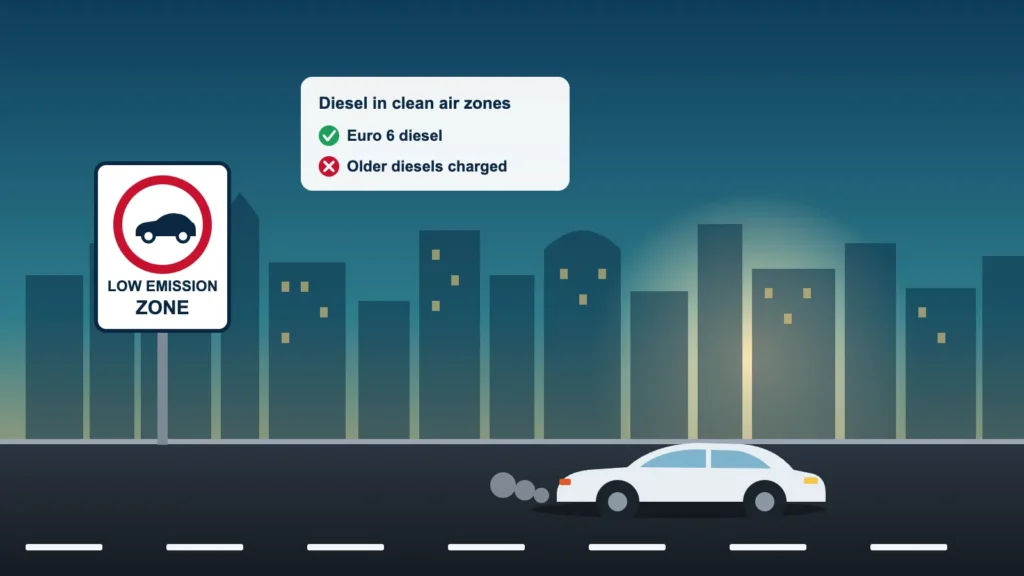
Is Europe banning diesel cars? What low-emission zones, the UK's 2030 rule and the EU's 2035 plan mean for your diesel, at home and abroad.
Headlines keep saying that Europe is banning diesel. The reality is more complicated. No country has banned you from driving a diesel you already own. What is happening is two separate things: cities are restricting or charging older, more polluting diesels through low-emission zones, and governments are ending the sale of brand-new petrol and diesel cars. This guide explains what is in force in 2026, in the UK and across Europe, what it means for your diesel, and how to keep it clean, legal and ready for its MOT.
Last updated: 30 October 2026.
The short answer
- You can still drive, buy, sell and service a used diesel in the UK and across Europe.
- Older diesels, usually those that don't meet the Euro 6 standard (roughly cars first registered before September 2015), are charged or banned in a growing number of city zones.
- In the UK, new cars that run only on petrol or diesel stop being sold from 2030. New hybrids can be sold until 2035. Cars already on the road aren't affected.
- The EU's 2035 rule for new cars is being softened, but nothing is final yet (October 2026).
Why diesel is being targeted
Diesel engines produce more nitrogen oxides (NOx) than petrol engines, and older diesels without a particulate filter also release fine soot particles. Both are linked to breathing problems, especially in busy city streets where traffic is heaviest. Each new European emissions standard (Euro 1 to Euro 6) cut the legal limits, and Euro 6 cut the NOx limit for diesel cars by more than half compared with Euro 5. That's why most clean air rules draw the line at Euro 6 for diesel and Euro 4 for petrol.
Is my diesel Euro 6?
As a rough guide, diesel cars first registered from September 2015 are usually Euro 6, and petrol cars from 2006 are usually Euro 4. Some earlier cars meet the standard too, so don't rely on the date alone:
- Check your V5C log book. Newer vehicles often show the Euro standard.
- Use the official checkers: GOV.UK's Clean Air Zone checker, Transport for London's vehicle checker for the ULEZ, or Scotland's vehicle emissions check service.
- If in doubt, ask the manufacturer for a certificate of conformity.
Diesel rules in the UK in 2026
London's Ultra Low Emission Zone (ULEZ)
The ULEZ covers all London boroughs and runs 24 hours a day, every day except Christmas Day. Cars must meet Euro 6 (diesel) or Euro 4 (petrol), or pay a daily charge. Transport for London points out that compliance depends on a vehicle's declared emissions, not just its age.
Clean Air Zones in England
Several English cities run Clean Air Zones. Only the class D zones charge private cars:
| City | Zone class | Private cars charged? |
|---|---|---|
| Birmingham | D | Yes, if not Euro 6 diesel or Euro 4 petrol |
| Bristol | D | Yes, if not Euro 6 diesel or Euro 4 petrol |
| Bath | C | No |
| Bradford | C | No |
| Sheffield | C | No |
| Tyneside (Newcastle and Gateshead) | C | No |
| Portsmouth | B | No |
You can check any vehicle on GOV.UK before you drive, and you have until 11:59pm on the sixth day after driving into a zone to pay.
Low Emission Zones in Scotland
Scotland's four largest cities have Low Emission Zones that apply to cars: Glasgow (enforced from 1 June 2023), Dundee (30 May 2024), Aberdeen and Edinburgh (both 1 June 2024). Diesel cars need Euro 6 and petrol cars Euro 4. Driving a non-compliant car into a zone leads to a penalty charge rather than a daily fee.
The 2030 rule for new cars
From 2030, carmakers can no longer sell brand-new cars that run purely on petrol or diesel in the UK. New hybrids and plug-in hybrids can still be sold until 2035, after which new cars must be zero emission at the tailpipe. The government is reviewing the annual electric car sales targets for manufacturers in 2026, but ministers have said the 2030 and 2035 dates aren't moving.
Most importantly, the rule only covers new car sales. You can keep, drive, service, MOT and sell a petrol or diesel car after 2030.
A regular service keeps the filter, injectors and emissions in good shape. Enter your registration and postcode for a fixed price, with free collection and return.
Diesel rules across Europe in 2026
There is no single EU-wide diesel ban. Each country, and often each city, sets its own rules, and a sticker from one country is rarely accepted in another. If you're taking your car abroad, check every city on your route before you set off.
France
France has low-emission zones (ZFE) in more than 40 towns and cities, according to the European Consumer Centre. Inside them you need a Crit'Air sticker, which shows how clean your car is on a scale from 0 to 5. Order it only from the official website, certificat-air.gouv.fr. In Greater Paris, older Crit'Air 4 and 5 cars are already restricted. Crit'Air 3 cars (which include diesels registered before 2011) were due to follow, but the Greater Paris authority has extended a grace period without fines for them until the end of 2026. A move to scrap ZFEs nationally was struck down by France's Constitutional Council on 21 May 2026, so the zones remain in place.
Belgium
Brussels has tightened its zone: since 1 January 2026, diesel cars must meet at least Euro 6 to drive in the city. Antwerp and Ghent require foreign-registered cars to be registered before entering, which is free if the car meets the rules.
Germany
Germany has 36 environmental zones (Umweltzonen), and almost all of them only allow cars with the green Umweltplakette sticker on the windscreen. This applies to foreign-registered cars too. Many zones have been lifted as air quality has improved, so check your destination before you travel.
The Netherlands, Spain and Italy
- Netherlands: zones are enforced by cameras, so there's no sticker or registration, but the rules differ by city. Utrecht's zones have been stricter since 2025.
- Spain: Barcelona requires foreign vehicles to register before entering its low-emission zone. Spain accepts the French Crit'Air sticker as proof of your car's category.
- Italy: many historic centres are limited traffic zones (ZTL). In Emilia-Romagna, Euro 5 diesels have been restricted in larger towns on winter weekdays since 1 October 2025.
The EU's 2035 plan: what's changing
The EU originally agreed that every new car sold from 2035 must be zero emission at the tailpipe. In December 2025, the European Commission proposed softening this to a 90% cut in CO2 emissions, which would allow some hybrids and combustion engines to stay on sale. On 22 October 2026, two European Parliament committees (Industry and Transport) backed a compromise. It starts from a 95% cut that could fall to 87.5% for carmakers using European-made low-carbon steel. The Environment Committee, the full Parliament and EU governments still have to agree, so nothing is final yet.
Whatever the outcome, the 2035 rule applies to new cars only. Existing diesels can still be driven.
Should you keep your diesel?
For many drivers, a well-maintained Euro 6 diesel still makes sense, especially if you do lots of motorway miles. An older diesel can become expensive if you regularly drive into London, Birmingham, Bristol or a Scottish city centre. Before you buy a used diesel:
- Check its Euro standard with an official checker.
- Look at its MOT history on GOV.UK for advisories about smoke, emissions or the particulate filter.
- Ask for the service history, including oil changes with the correct oil grade.
- Think about how you'll use it. Lots of short trips are hard on a diesel particulate filter.
Keeping your diesel clean, legal and MOT-ready
A diesel that's looked after is cleaner, more reliable and much more likely to pass its MOT first time:
- Look after the particulate filter (DPF). It needs regular longer drives at steady speed to burn off soot. A DPF warning light is a sign to act quickly. Our guide to blocked DPF symptoms explains the causes and fixes.
- Use the right oil. Many diesels with a DPF need a specific low-ash oil, so follow the grade in your handbook.
- Don't run out of AdBlue. Many Euro 6 diesels use it to cut NOx. If it runs out, the car may not restart until it's topped up.
- Get smoke and warning lights checked. EGR valve, injector and sensor faults can cause smoke, poor running or limp mode. A diagnostic check finds the cause before it gets worse.
Will it affect your MOT?
The MOT doesn't check whether your car can enter a clean air zone, but it does test diesel emissions. Under the MOT inspection manual, each of these is a major defect and a fail:
- evidence that the diesel particulate filter has been tampered with
- visible smoke of any colour from a car fitted with a DPF
- smoke levels above the manufacturer's limit or the default limit
Removing a DPF won't make a car cleaner or legal, and it will fail its MOT. See how emissions fit into the wider picture in our MOT failure rate statistics, our guide to MOT defect categories and every MOT change in 2026. Thinking about switching? Our electric vehicles guide covers the basics.
Book your MOT at an approved test centre, discounted when you book it with a service. Repairs come with a 12-month parts and labour warranty.
Frequently asked questions
Is diesel being banned in the UK?
No. Driving an existing diesel isn't banned anywhere in the UK. Sales of new cars that run only on petrol or diesel end in 2030, and some cities charge older diesels to enter certain zones.
Do I need a sticker to drive my diesel in France?
Yes, if you drive into a low-emission zone. You need a Crit'Air sticker, ordered from the official website certificat-air.gouv.fr, and your car must be in a category the zone allows. Allow time for it to arrive by post before you travel.
Which UK zones charge private cars?
London's ULEZ, the Birmingham and Bristol Clean Air Zones and Scotland's four Low Emission Zones apply to cars that don't meet Euro 6 (diesel) or Euro 4 (petrol). Bath, Bradford, Portsmouth, Sheffield and Tyneside don't charge private cars.
Is a Euro 6 diesel allowed in every zone?
In the UK, yes. A Euro 6 diesel meets the ULEZ, Clean Air Zone and Scottish LEZ standards. Abroad, rules vary. Most current zones accept Euro 6 diesels, but some cities plan stricter rules, so check before each trip.
Will my diesel fail its MOT because of clean air rules?
No. The MOT doesn't test zone compliance. It tests emissions, smoke and the particulate filter, so a well-maintained diesel that meets its limits will pass.
Book your diesel in with Hon Car Service
Hon Car Service is an online booking platform for car servicing, MOTs and repairs across the UK. Enter your car registration and postcode for a fixed price, choose free collection and return, and pay only after the work is done and approved. Repairs come with a 12-month parts and labour warranty, and MOTs are carried out at approved test centres. Get an instant quote.