
MOT Changes 2026: Every New Rule Explained (Updated October 2026)
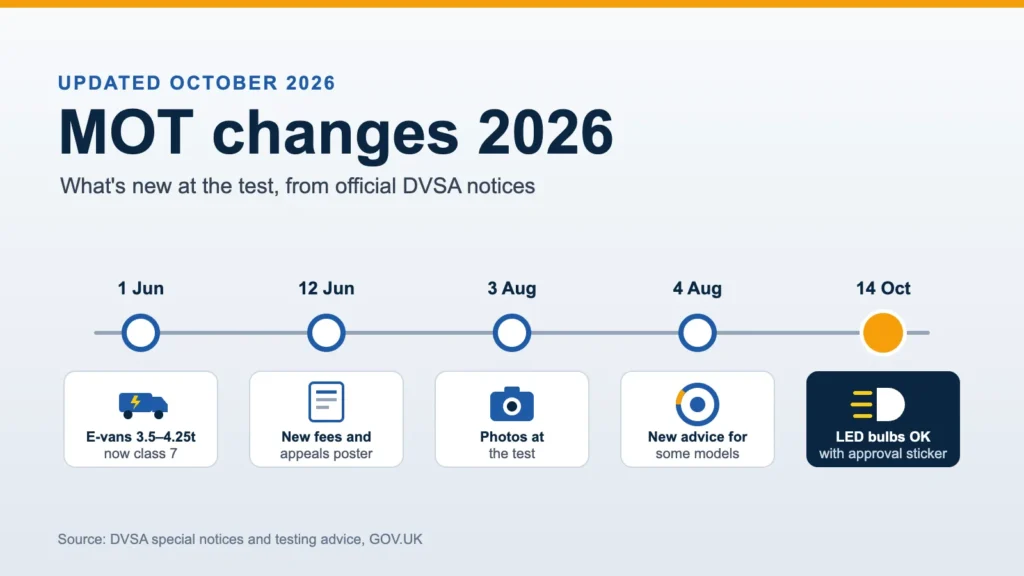
Every MOT change in 2026 explained: approved LED headlight bulbs, photos at the test, new advice for some models and what hasn't changed.
The MOT test doesn't stay still. During the year, the Driver and Vehicle Standards Agency (DVSA) sends MOT testers "special notices" and updated guidance that change how cars are tested. Most drivers never hear about them until their own MOT. This page lists every change in 2026 that can affect you as a driver, explains each one in plain English and links to the official source. It's written with input from a qualified MOT tester at Hon Car Service, and we update it whenever DVSA publishes something new.
Last updated: 29 October 2026.
MOT changes in 2026 at a glance
| Date | What changed | Who it affects |
|---|---|---|
| 14 October 2026 | Approved LED replacement bulbs accepted in halogen headlamps, if the approval sticker is fitted | Cars, vans and minibuses with halogen headlamps and LED bulbs fitted |
| 4 August 2026 | Updated testing advice for some Jaguar, Land Rover and Volkswagen Golf R models | Jaguar and Land Rover models with an electronic parking brake; Golf R 2.0 with engine code DNFF |
| 3 August 2026 | National rollout of photos of the vehicle at the time of the test | All drivers (garages are joining in phases) |
| 12 June 2026 | New MOT test fees and appeals poster in every test centre | All drivers |
| 1 June 2026 | Zero emission goods vehicles between 3,501kg and 4,250kg become class 7 | Owners of heavier electric vans |
| Early 2026 | New testing advice for the BMW iX bonnet and Tesla Model 3 and Model Y rear ball joints | BMW iX, Tesla Model 3 and Model Y owners |
1. LED replacement headlight bulbs: the new sticker rule (14 October 2026)
Until now, fitting LED bulbs into headlamps designed for halogen bulbs usually meant an MOT fail. DVSA special notice 05-26 changed that. Since the MOT inspection manual was updated on 14 October 2026, testers must accept ECE approved LED replacement bulbs (known as "LEDr") in compatible halogen headlamp units.
Which vehicles it covers
- Covered: class 3, 4, 5 and 7 vehicles (cars, vans, minibuses and light goods vehicles) with their original halogen headlamp units, fitted with ECE approved LED replacement bulbs.
- Not covered: motorcycles (classes 1 and 2), halogen headlamps converted to HID (xenon) bulbs, and full LED headlamp unit replacements.
What the approval sticker must show
Approved LEDr bulbs come with a secure approval sticker. It must be permanently fixed to the vehicle where it can be easily seen during the MOT. The sticker must include:
- the category (for example, H11 LEDr)
- the variant
- the rated voltage
- the ECE approval number
- the manufacturer's name
- a security feature, such as a hologram
The tester checks that the sticker is there. They don't need to look up the approval number or manufacturer in a database.
When the headlamp fails
If LED replacement bulbs are fitted, the headlamp fails if:
- there's no sticker
- the sticker can't be read
- the sticker looks like it's been tampered with
- the sticker clearly doesn't match the bulb fitted
Any of these is a major defect ("light source and lamp not compatible"), so the car fails the MOT.
What drivers should do
- Only buy LED replacement bulbs that are ECE approved for your headlamp and come with the approval sticker. "Road legal" in an online listing isn't proof.
- Fit the sticker where it's easy to see, and don't peel it off or cover it.
- Keep the packaging and fitting information with your car's paperwork.
- If you already have LED bulbs with no sticker, expect them to fail. Refitting the correct halogen bulbs before the test is the simple fix.
Source: MOT special notice 05-26 (GOV.UK, 13 October 2026). For background, read our news story on approved LED headlight bulbs and the MOT.
Enter your registration and postcode for a fixed price. Book your MOT at an approved test centre, discounted when you book it with a service.
2. Jaguar, Land Rover and Volkswagen Golf R: updated testing advice (4 August 2026)
After technical investigations with the manufacturers, DVSA updated its testing advice for some models. It only changes how these cars are tested, not the standard they have to meet.
Jaguar and Land Rover models with an electronic parking brake
The advice covers all Jaguar models with an electronic parking brake and Land Rover models with electronic parking brake actuators fitted to the brake calipers.
- If the car judders, vibrates excessively or shows signs of transmission wind-up on the brake rollers, the tester must stop the test and take the car off the rollers. DVSA says this may point to a separate mechanical or drivetrain issue outside the scope of the MOT.
- Decelerometer and gradient tests are not suitable for checking the parking brake on these vehicles. The parking brake is tested on a plate brake tester or on a roller brake tester in manual mode, following set procedures.
If this happens to your car, it's worth having the drivetrain checked before the test is booked again.
Volkswagen Golf R 2.0 with engine code DNFF and four exhaust outlets
These cars need a specific emissions testing procedure to get a valid lambda reading. Without it, the car could wrongly fail the lambda check. The engine code is shown on the engine or on the vehicle data sticker, usually under the boot floor covering. If you own one, it's worth mentioning it when you book.
Source: Testing advice for cars and passenger vehicles (GOV.UK, updated 4 August 2026).
3. Photos of your car at the MOT (from 3 August 2026)
DVSA special notice 04-26 started the national rollout of a feature that lets testers take a photo of the vehicle at the time of the test and upload it straight to the MOT testing service. The rollout began on 3 August 2026, with around 2,500 garages across Great Britain getting access in the first phase.
- Why: to deter fraud, reduce the risk of MOT certificates being issued when the vehicle isn't there, and help with vehicle identity checks.
- Is it compulsory? Not yet. For now the photo is optional, but DVSA says it may become mandatory later.
- What it means for you: don't be surprised if the tester photographs your car during the MOT. The photos are uploaded directly to the MOT testing service, not kept in the device's camera roll.
Source: MOT special notice 04-26 (GOV.UK, 29 July 2026).
4. New MOT fees and appeals poster (by 12 June 2026)
Every MOT test centre must display the official fees and appeals poster. Special notice 02-26 told test centres to put up a new version by 12 June 2026. The new poster covers the class 7 change, includes a QR code linking to the appeals process on GOV.UK, and has information about photos at the time of test.
The maximum MOT fee for a car is still £54.85. If you think your car failed wrongly, the poster and GOV.UK explain how to appeal. Our guide to MOT retest rules explains when a retest is free.
Source: MOT special notice 02-26 (GOV.UK, 4 June 2026).
5. Heavier electric vans move to class 7 (1 June 2026)
Special notice 01-26 confirmed that from 1 June 2026, zero emission goods vehicles weighing between 3,501kg and 4,250kg became class 7 vehicles and need a class 7 MOT test. If you run a heavier electric van, make sure the test centre you book can test class 7 vehicles.
Source: MOT special notice 01-26 (GOV.UK, 13 May 2026).
6. BMW iX and Tesla Model 3 and Model Y: model-specific advice (early 2026)
DVSA's testing advice for specific vehicles also gained guidance for two popular electric models this year.
- BMW iX: the bonnet is released with two concealed pull cables beneath the dashboard, one on each side. It won't stay open on its own because no gas struts or hydraulic supports are fitted, so the tester props it open during the inspection. As an owner, there's nothing you need to do.
- Tesla Model 3 and Model Y: DVSA's advice points testers to Tesla's own MOT information and procedures, including for the rear knuckle ball joints, so any play is judged against the manufacturer's limits.
Source: Testing advice for cars and passenger vehicles (GOV.UK).
What hasn't changed in 2026
- First MOT: still due by the third anniversary of the car's registration in England, Scotland and Wales.
- Maximum fee: still £54.85 for a car.
- Booking early: you can still get an MOT up to a month (minus a day) before it runs out and keep the same renewal date.
- Driving without an MOT: you can still be fined up to £1,000.
- The checks: lights, tyres, brakes, suspension and visibility are still the most common reasons for failure. See our MOT failure rate statistics for the latest DVSA figures.
Will these changes affect your MOT?
- Fitted LED headlight bulbs? Check for the approval sticker before the test.
- Driving a Jaguar or Land Rover with an electronic parking brake? If the car judders or vibrates on the brake rollers, the tester will stop the test, and you should have the drivetrain checked.
- Golf R 2.0 (DNFF) with four exhausts? Mention it when you book so the right emissions procedure is used.
- Running an electric van over 3,500kg? Book a test centre that can test class 7.
- Driving a Tesla Model 3 or Model Y? The rear knuckle ball joints are checked against Tesla's own limits.
- Everyone else: the usual five-minute checks still prevent the most common fails. Our pre-MOT checklist takes you through them.
How we keep this page up to date
We check DVSA's MOT manuals, checklists and special notices on GOV.UK and add each change that affects drivers, with the date and a link to the source. Changes that only affect how test centres are run, such as tester sign-in rules or test bay equipment, are left out.
How Hon Car Service can help
Hon Car Service is an online booking platform for car servicing, MOTs and repairs across the UK. Enter your car registration and postcode for an instant fixed price with parts and labour included. Your MOT is carried out at an approved test centre and is discounted when you book it with a service. Choose free collection and return, a mobile mechanic at home or work for repairs, or a trusted local garage. Your card is pre-authorised when you book and only charged after the work is done and approved, and every job comes with a 12-month parts and labour warranty.
Book your MOT online at an approved test centre, with free collection and return and a fixed price before you book.
FAQs
Are LED headlight bulbs legal for the MOT in 2026?
Since 14 October 2026, ECE approved LED replacement bulbs are accepted in compatible halogen headlamps, as long as the approval sticker is permanently fitted and visible. LED bulbs without the sticker, HID conversions and full LED headlamp unit replacements aren't covered.
What does the LED bulb approval sticker need to show?
The category (for example, H11 LEDr), the variant, the rated voltage, the ECE approval number, the manufacturer's name and a security feature such as a hologram.
Will my car be photographed at its MOT?
It might be. Since 3 August 2026, DVSA has been rolling out a feature that lets testers photograph the vehicle at the time of the test. It's optional for now and is mainly there to prevent fraud.
Has the MOT fee gone up in 2026?
No. The maximum fee for a car MOT is still £54.85, and many test centres charge less.
Why was my Jaguar or Land Rover MOT stopped on the brake rollers?
For Jaguar and Land Rover models with an electronic parking brake, DVSA's advice is that if the car judders, vibrates excessively or shows transmission wind-up on the rollers, the tester must stop the test and remove it from the rollers. DVSA says this may indicate a separate mechanical or drivetrain issue.
When is a car's first MOT?
By the third anniversary of its registration in England, Scotland and Wales. That hasn't changed in 2026.