
UK MOT Results Explained: Dangerous, Major and Minor Defects
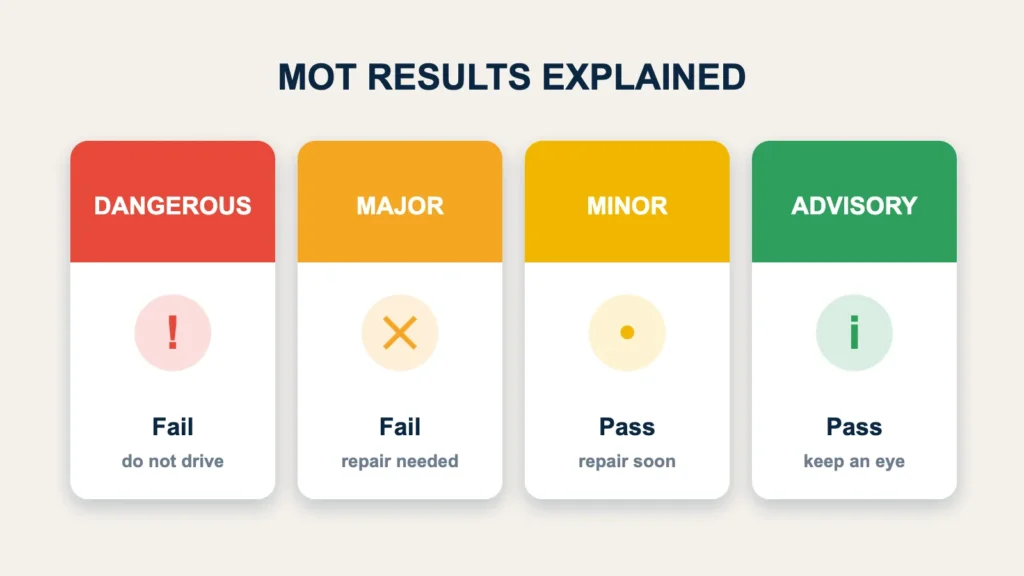
Booking an MOT near me? Learn what dangerous, major and minor defects and advisories mean, and which ones cause a fail.
Every MOT result sorts problems into three defect categories: dangerous, major and minor. A dangerous or major defect means the car fails, while minor defects and advisories are recorded on a pass. If you are searching for an MOT near me, the categories work the same way at every approved test centre in Great Britain. Here is what each one means for you and your car.
Instead of a simple pass or fail, the categories show how serious each issue is and how quickly it needs attention, which makes repairs easier to plan.
The four types of item on an MOT result
The tester checks your car against the official inspection standards and records anything they find. Each item is placed in one of these groups:
- Dangerous: a direct and immediate risk to road safety, or a serious impact on the environment. The car fails.
- Major: a defect that may affect the vehicle's safety, put other road users at risk or harm the environment. The car fails.
- Minor: a defect with no significant effect on safety or the environment. The car can still pass, but the fault should be repaired as soon as possible.
- Advisory: something that could become more serious in future, such as wear the tester wants you to keep an eye on. Advisories do not cause a fail.
You can see the items recorded at previous tests, including advisories, using the free GOV.UK "check MOT history" service.
Dangerous and major defects: what a fail means
Dangerous defects
If your car has a dangerous defect, you should not drive it until it has been repaired. That applies even if your current MOT certificate has not yet run out.
Major defects
A major defect also means a fail, and the problem should be repaired straight away. If your previous MOT is still valid and there are no dangerous defects, you may be able to drive the car to a garage for repair. Once the old certificate has expired, you can only drive to a pre-booked MOT, or to and from a garage for repairs needed to pass. Outside those exceptions, driving without a valid MOT can bring a fine of up to £1,000.
Our guide on what to do after a failed MOT walks through your options in more detail.
Minor defects and advisories: passing with notes
A pass with minor defects or advisories is still a pass. You get your certificate and can carry on driving. Even so, these notes are worth reading carefully:
- Minor defects should be fixed as soon as possible, before they get worse.
- Advisories point to parts that are wearing, such as tyres or brake components.
- Ignoring either can turn a small issue into a major defect at your next test.
Tyres are a common example. The legal minimum tread depth is 1.6mm across the central three-quarters of the tread, around the whole circumference. An advisory for tyres close to that limit is a clear sign to plan replacements. Our guide to whether a car can pass its MOT with a fault covers more examples.
MOT defect categories at a glance
| Category | Result | Can you drive the car? | What to do next |
|---|---|---|---|
| Dangerous | Fail | No, not until it is repaired | Have it repaired before the car is driven |
| Major | Fail | Only if the old MOT is still valid, or to a garage for repairs needed to pass | Repair straight away, then retest |
| Minor | Pass | Yes | Repair as soon as possible |
| Advisory | Pass | Yes | Monitor it and plan the repair |
Your MOT is carried out at an approved MOT test centre, with free collection and return.
How retests work after a fail
After repairs, the cost of the retest depends on where the car is and how quickly it comes back:
- Left at the test centre for repair and retested within 10 working days: a free partial retest.
- Taken away and brought back by the end of the next working day for certain items, such as lights, wipers, mirrors, doors or number plates: free.
- Brought back within 10 working days: a partial retest at up to half the maximum fee.
- After 10 working days: a full MOT at the full fee.
Our guide to MOT retest rules explains each case in more detail.
Choosing an MOT near me that explains results clearly
A good result is one you understand. Approved MOT test centres display a blue sign with three white triangles, and the tester should be able to explain each item on your result in plain language.
When you book through Hon Car Service, you get live photo updates, so you can see what has been found. Any extra work needs your approval first, and your card is authorised at booking but only charged after the work is done and approved. If you are booking an MOT in Southampton, Eastleigh, Totton or elsewhere in Hampshire, the process is the same.
Frequently asked questions
Can a car fail its MOT because of an advisory?
No. Advisories are notes about parts that may need attention in future. They do not cause a fail, but it is sensible to plan repairs before they become defects.
Is a minor defect a fail?
No. A car with minor defects can pass. The defects are listed on the result and should be repaired as soon as possible.
How do I find an MOT near me I can trust?
Look for an approved MOT test centre with the blue sign showing three white triangles. Booking online with a fixed price and photo updates also helps you see exactly what was found and why.
Where can I see past defects and advisories?
Use the free GOV.UK "check MOT history" service. Enter the registration to see previous results, including any advisories.
Enter your registration and postcode for a fixed price with parts and labour included.