
Clicking When Turning? CV Joint Symptoms and Split Boot Repairs
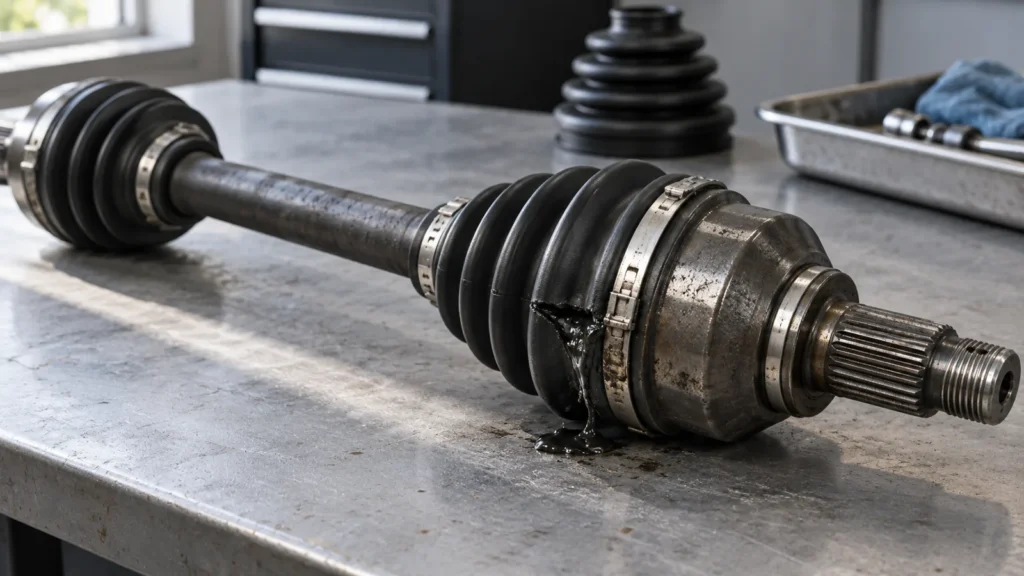
Clicking on turns or grease near a wheel? Understand CV joint symptoms, split boot repairs, MOT rules and the checks needed before replacing a driveshaft.
A repeated clicking noise while turning can point to a worn outer CV joint, especially when it occurs as the car moves under power. A split CV boot is another important clue, but a noise alone cannot confirm which component or side needs replacing. Steering, suspension and wheel-related faults can sound similar.
Hero image: AI-generated illustration, not a photograph of a customer repair.
What does a CV joint do?
A constant velocity joint allows a driveshaft to transmit drive while accommodating movement. The outer joint is towards the wheel; the inner joint is towards the gearbox or differential. Their arrangement varies with the vehicle and drivetrain.
The flexible boot around the joint retains grease and helps keep contamination out. A boot is a protective component, not the joint itself, so “CV boot replacement” and “CV joint replacement” are different jobs.
Which symptoms are useful clues?
- Repeated clicks on a moving turn: an outer CV joint is one possibility worth inspecting.
- A clunk when taking up drive: the inspection may need to include inner joints, mountings and other driveline components.
- Shudder under acceleration: record the circumstances; do not assume every vibration is wheel imbalance.
- Humming or vibration mainly with road speed: wheel, tyre and bearing checks may be more relevant than a CV joint.
TrakMotive’s technical bulletin distinguishes these patterns. They guide inspection rather than provide a remote diagnosis. Do not use the direction of a turn alone to order a left- or right-hand driveshaft.
Why does a split CV boot matter?
A damaged boot can allow grease loss and contamination, accelerating joint wear. Grease thrown around the inner wheel area is worth reporting, although an inspection is needed to establish where it came from.
GKN’s workshop guidance calls for checking boots, clamps, shaft condition and joint play. Looking at the rubber alone is not enough to establish the condition of the joint inside.
Can you replace just the boot?
Sometimes, if inspection confirms the joint remains serviceable. If the joint is already worn or damaged, a new boot will not reverse that wear. Depending on the vehicle, parts availability and findings, the repair may involve a boot kit, joint kit or complete driveshaft.
Ask the technician to explain the finding and the proposed repair scope. The cheapest part price is not necessarily the lowest complete repair cost, and replacement of both sides should not be assumed without evidence.
Will a split CV boot fail an MOT?
The DVSA manual, section 6.1.7, distinguishes two conditions: a severely deteriorated CV boot is a minor defect; one that is missing, split or insecure so it no longer prevents dirt entering is a major defect. Excessive transmission-joint wear is also assessed separately.
A previous MOT pass does not establish that a new noise is safe. Have a new or worsening symptom checked rather than waiting for the next test.
Is it safe to keep driving?
There is no reliable mileage allowance for a clicking joint. Arrange a prompt assessment. If there is severe vibration, repeated heavy banging, altered steering or loss of drive, stop in a safe place and arrange appropriate assistance. Do not deliberately recreate the fault at speed or drive tight circles beside traffic.
You can record observations without dismantling anything. Do not crawl under a car supported only by a jack, and do not touch rotating shafts.
What should I include when asking for a quote?
- Registration, mileage, location and whether the vehicle is safely parked.
- Whether the sound occurs on left turns, right turns or both, and whether it happens while stationary.
- Whether acceleration, braking, bumps or road speed change it.
- Any recent tyre, suspension or driveshaft work and any visible grease.
Ask whether the quote covers diagnosis, the specified boot or joint, labour and necessary fitting items. A vehicle-specific inspection is more useful than comparing unrelated online CV joint replacement prices.
Related guides
- Bouncing over bumps and rear shock absorbers
- Whining steering and power steering fluid leaks
- Wheel balancing versus alignment
Book it with HON CAR SERVICE
Choose suitable repair support after the affected component has been identified. Explore available services and check eligibility for your vehicle and postcode. Describe an undiagnosed fault before choosing replacement parts.