
Car Bouncing Over Bumps? Rear Shock Absorber Replacement
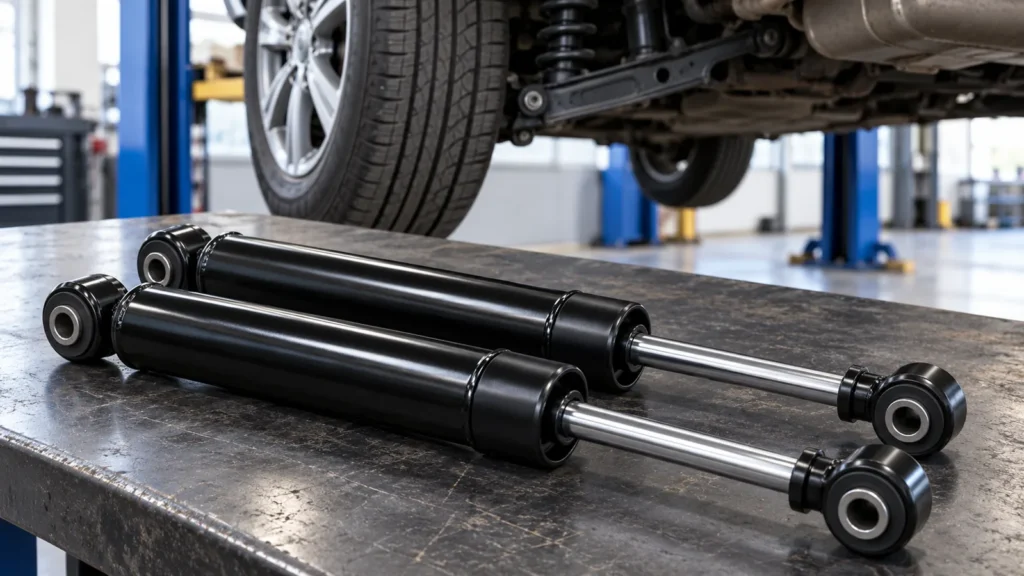
Car bouncing over bumps or knocking from the rear? Learn the signs of worn shock absorbers, why pairs matter, what replacement involves and the MOT rules.
A car that keeps bouncing after a bump may have worn shock absorbers, but the symptoms need checking before parts are replaced. Rear knocking, an unsettled ride or uneven tyre wear can also involve springs, mountings, bushes or tyres. A suspension inspection should establish what is actually worn and whether the car is safe to drive.
Describe the symptoms and check suitable inspection options.
What do rear shock absorbers do?
The springs support the vehicle and react to bumps. Shock absorbers, also called dampers, control the continuing movement afterwards. When damping deteriorates, the body and wheels can move less predictably. That affects more than comfort: tyre contact and vehicle control matter when braking and cornering.
KYB lists excessive bouncing, instability and tyre flat spots among reasons to have the suspension checked. Wear can develop gradually, so a driver may become used to a worsening ride.
Does knocking over bumps mean the rear shocks have failed?
No. A knock is a clue, not a diagnosis. The inspection should consider the damper mountings, bushes, springs and other suspension components. Explain whether the sound happens on one side, with passengers or luggage, or on a particular kind of road surface. Do not deliberately hit potholes to demonstrate it.
What about uneven tyre wear?
It is another reason to investigate, rather than proof that a shock absorber is responsible. Have the tyres and the rest of the suspension assessed together. Simply replacing a damper without understanding the wear pattern can leave part of the problem unresolved.
Does oil on a shock absorber mean it needs replacing?
Not every trace of oil means failure. Monroe distinguishes slight surface weepage from leakage that leaves much of the unit wet or produces drips. Condition and damping performance must be assessed together; wiping the unit clean does not repair a leak.
Do not crawl under a vehicle supported only by its emergency jack. A photograph taken safely from outside may help explain your concern, but it cannot establish the condition of hidden fixings or bushes.
Should both rear shock absorbers be replaced together?
For conventional worn dampers, replacing the two on the same axle is the normal manufacturer recommendation. KYB explains that significantly different damping from side to side can produce inconsistent body and wheel movement, affecting handling and comfort.
That means a matched rear pair, not automatically all four dampers. Ask the repairer to explain the condition of the opposite side and the vehicle manufacturer's requirements. Electronic, adaptive and self-levelling systems need the correct compatible components.
What happens during rear shock absorber replacement?
A professional repair starts with identifying the correct suspension design and parts. Some cars have separate rear springs and dampers; others use a combined assembly or a more complex system. A short video of one car does not provide the procedure for another.
At a high level, the technician safely supports the vehicle and relevant suspension components, removes the old damper, checks associated mounting and protection parts, and fits the replacement to the specified procedure. Correct fixings, tightening requirements and final checks depend on the vehicle. Springs store energy, so this is not a universal home-jack repair guide.
Before authorising the job, ask whether the quote covers:
- One rear damper or a matched pair.
- The specified parts for your suspension type.
- Necessary bushes, mountings, dust covers, bump stops and replacement fixings.
- Labour, VAT and any agreed additional work.
Prices and access vary by vehicle. Compare the actual work included rather than assuming the cheapest headline price covers the same repair.
Will worn shock absorbers fail an MOT?
Under the current DVSA manual for cars in Great Britain, severe leakage, a non-functioning damaged damper, excessive bush wear or negligible damping can be major defects. A missing or likely-to-detach shock absorber is listed as dangerous. Slight seepage forming a fluid film is not, on its own, a rejection reason.
A recent MOT pass is not a guarantee of the suspension's present condition. Have new symptoms checked instead of waiting until the next test. A simple driveway bounce test cannot certify the suspension as safe.
Can I keep driving a bouncing car?
If the car feels unstable, is difficult to control, has a visibly damaged component or makes a sudden severe noise, stop safely and ask a repairer or breakdown provider how it should be moved. Do not drive it to a booking merely because an appointment is available. Milder persistent symptoms still deserve a prompt inspection.
Enter your vehicle and postcode to check available booking options.
Related reading
Sources
- KYB Europe: suspension function and symptoms
- KYB: why dampers should be replaced in pairs
- Monroe: weepage versus leakage
- DVSA MOT manual, section 5.3.2
Written by HON CAR SERVICE. Follow vehicle-specific repair information. Hero image is an original AI-generated illustration of generic rear dampers.