
Fuel Gauge Not Working? Wrong Readings and Fuel Sender Faults
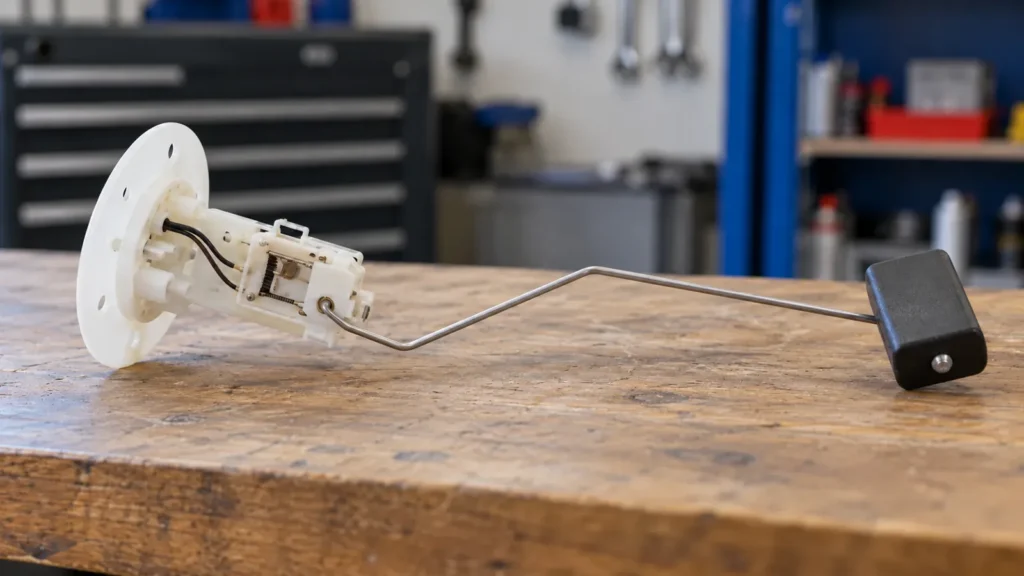
Fuel gauge stuck on full, empty or giving wrong readings? Learn what a fuel sender does, how faults are checked and why replacing the pump may be unnecessary.
If your fuel gauge is stuck on full, reads empty after filling or changes unpredictably, the fuel level sender is one possible cause—but replacing it is not the first step. Wiring, connections and the dashboard display also need consideration. Some apparent faults after refuelling are model-specific display behaviour.
Hero image: AI-generated illustration, not a photograph of a customer repair.
What does the fuel level sender do?
In a common design, a float moves with the fuel level and operates a sensor that supplies information to the gauge. The sender may be separate or part of an in-tank pump assembly. The exact design and test values depend on the vehicle.
Delphi explains the sender’s role and why a faulty sender, wiring or gauge can produce misleading readings. Do not assume that a gauge problem means the fuel pump itself has failed.
What can different symptoms mean?
- Stuck on empty or full: a sender or circuit fault needs investigation.
- Reading changes erratically: intermittent electrical contact or sticking sender movement may be involved.
- Wrong since fuel-pump or tank work: tell the repairer exactly when it began so the installation and connections can be checked.
- Several dashboard functions fail together: report all of them rather than describing only the fuel reading.
These clues do not identify a replacement part by themselves. A fault report should distinguish the displayed reading from the actual fuel added and the car’s behaviour.
Why might it not show full immediately after filling?
First check the handbook. An older Suzuki bulletin for 2006–2008 Grand Vitara JB627 models describes different gauge-response modes and warns against replacing the instrument cluster for that particular refuelling behaviour. That example shows why model information matters; its timing and advice must not be applied to every car.
Always switch the engine off for refuelling and follow forecourt instructions. If the reading remains implausible or the problem repeats, arrange assessment rather than assuming it is normal.
How is a fuel gauge fault diagnosed?
The technician needs to compare the sender signal, circuit condition and instrument response with the correct vehicle information. A scan may help where supported, but a fault code alone does not prove the sender needs replacement.
For example, HELLA’s guidance for the 2005–2011 Citroën C1 identifies sender contact problems as a possible cause and describes separate checks of the sensor and gauge. Its resistance figures are specific to those vehicles, not universal testing values.
Ask what was measured and whether the evidence rules out a connection or display fault. This is particularly useful before authorising an expensive complete pump module when the complaint is only an inaccurate gauge.
Can I drive with a broken fuel gauge?
The immediate risk is not knowing whether you have enough fuel to complete the journey. Do not deliberately run the tank empty to test the gauge, and do not rely on the distance-to-empty display as a guaranteed reserve. The AA advises against relying on that estimate.
Arrange diagnosis promptly and plan refuelling conservatively. Previous trip mileage is only a rough record, not proof of remaining fuel. If the car stalls, smells strongly of fuel or appears to leak, stop safely and seek suitable assistance rather than treating it as a display-only problem.
What can I check without opening the fuel system?
- Keep the last fuel receipt and note the quantity added, mileage and displayed reading.
- Record whether the issue appears only after refuelling, while parked or throughout a journey.
- Check the handbook for relevant display behaviour and retain any warning message.
- Tell the technician about recent repairs and whether other instruments are affected.
Do not open the tank, bypass wiring or use improvised electrical tests around fuel vapour. Fuel-system access and electrical testing should follow the manufacturer’s safety procedure.
What affects the repair cost?
The cause, sender availability and access to the tank determine the work required. Ask whether the sender is separately serviceable, what labour is included and what the diagnosis demonstrated. Avoid authorising a pump solely because the gauge is wrong.
Related guides
- Car clicks but will not start
- Engine management light and diagnosis
- Putting safety first after a breakdown
Book it with HON CAR SERVICE
Start with the fault and the appropriate diagnostic inspection, rather than choosing a fuel pump in advance. Explore available services and check eligibility for your vehicle and postcode. Describe an undiagnosed fault before choosing replacement parts.
Further source
Suzuki technical bulletin: fuel gauge response after filling, 2006–2008 Grand Vitara JB627. Sources checked 22 October 2026.