
Car Clicks but Won’t Start? Battery, Connections or Starter?
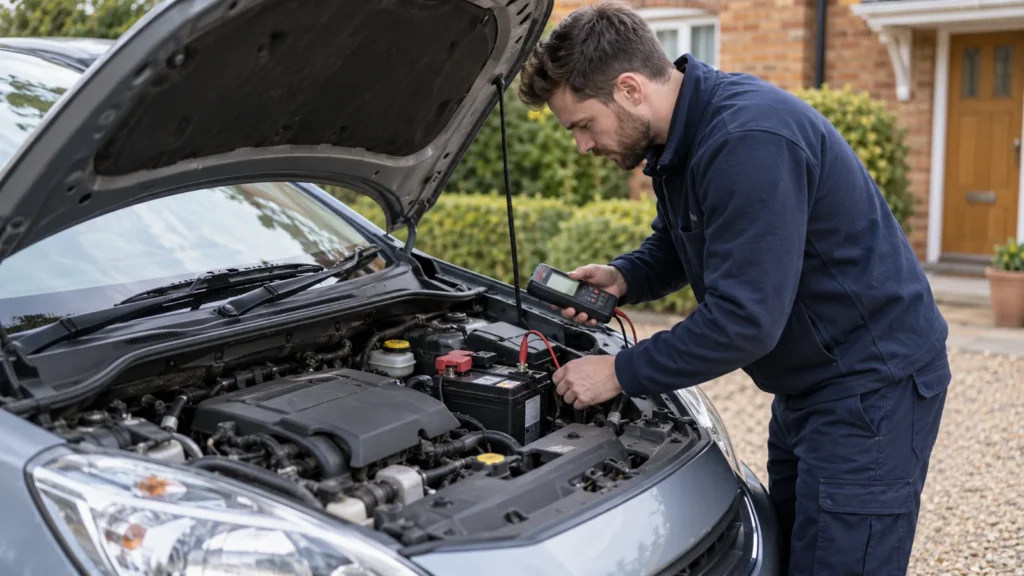
Car clicking but not starting? Learn why the battery, connections and starter need different checks, what to record and when to arrange assistance.
If your car clicks but won’t start, do not order a starter motor on the sound alone. A weak 12-volt battery, poor connections and a starter fault can produce overlapping symptoms. First establish whether the engine is turning over at all.
This guide is about a petrol or diesel engine that will not crank normally. If it turns at its usual speed but never fires, that is a different diagnostic problem. Hybrids and electric vehicles have model-specific starting systems; follow their handbook rather than applying conventional starter advice.
Starting problem? Describe the symptoms
A clear fault description helps identify the right inspection.
Rapid clicking or one click: what is the difference?
Repeated clicking can accompany an inadequate electrical supply. A single click without cranking can also involve the starter or its control circuit. Neither sound establishes which component needs replacing.
Note whether the sound is rapid or isolated, whether the engine moves, and whether the dashboard goes dim. Avoid repeated attempts just to recreate the noise.
Why the battery and connections come first
DENSO advises checking battery charge and the condition of cables, terminals and earth connections before condemning the starter. Resistance in a cable or connection can prevent enough current reaching it. Professional current-draw and voltage-drop tests help separate these faults from starter or mechanical problems, using the vehicle manufacturer’s limits.
A dashboard that lights up is therefore not a complete starting-system test. Tell the technician what still works, but do not take that observation as proof that the battery and cables are healthy. Read our battery terminal corrosion guide if you have noticed deposits; appearance alone does not show the whole circuit’s condition.
Can short journeys leave the battery low?
Yes. VARTA explains that frequent starts and electrical loads can use more energy than short journeys replace, particularly with an ageing battery. Long periods parked can also reduce charge. A low state of charge does not, by itself, establish that the battery has reached the end of its life.
Record your recent usage: daily short trips, a long period unused, lights left on or a previous discharge. These are useful clues to pass on, not reasons to fit a larger or different battery without checking the vehicle specification.
What can you check safely?
- Make sure you are parked safely, with the parking brake applied.
- Follow the handbook’s starting procedure, including the required gear position and pedal operation.
- Record any warning or key-recognition message exactly as displayed.
- Look for obvious damage only if you can do so safely with the vehicle switched off; do not touch terminals or moving components.
- Arrange assistance if the car will not start or is in an unsafe position.
Do not bridge starter terminals, bypass safety switches or crawl underneath an unsupported car. Do not attempt work on orange high-voltage cables. Jump-starting procedures differ: use the vehicle handbook and competent assistance rather than a generic sequence.
When should you stop trying?
A swollen battery, steam or a rotten-egg smell can indicate a hazardous battery problem, according to battery manufacturer Interstate. Stop attempts and keep away from a damaged or overheating battery. Smoke or fire requires urgent assistance, not further testing.
What should an inspection establish?
Ask for the cause of the no-crank condition to be explained before authorising parts. Useful questions include: was the battery assessed under the relevant test conditions, were connections checked, and what evidence points to the proposed repair?
DENSO also identifies starting-control faults such as relay or switch problems. Replacing a battery or starter without isolating the fault can leave the original complaint unresolved. For broader battery care, see our car battery guide; if charging is implicated, read what an alternator does.
What information should you give when booking?
Include the registration, location, whether the engine cranks, the clicking pattern, warning messages and any recent battery work. Say clearly that the vehicle cannot be driven. The appropriate appointment or recovery arrangement depends on its condition, location and the work required; online booking availability does not mean round-the-clock repairs.
Find the cause before replacing parts
Choose the appropriate inspection and describe the no-start symptoms.
Book it with HON CAR SERVICE
Choose the service that matches your vehicle and describe the problem when booking. Availability depends on your vehicle, location and the work required.
Diagnostic inspection · Browse services
Get a quoteRelated reading
- Battery terminal corrosion and slow starting
- Understanding your car battery
- Alternator and charging-system guide
Technical sources
- DENSO: starter troubleshooting
- VARTA: batteries and short journeys
- Interstate Batteries: battery warning signs
Published 20 October 2026. General guidance, not a diagnosis of an individual vehicle. Hero image is an original AI illustration, not a photograph of a HON customer job or a connection diagram.