
Car Battery Keeps Going Flat? Causes and What to Check
Repeated flat battery? Learn how parking, short trips, charging faults and electrical drain differ, and what to ask before replacing the battery.
If your car battery keeps going flat, replacing it without testing can leave you with the same problem. The fault may be an ageing 12V battery, insufficient charging, a poor connection or electrical equipment using power while the car is parked. The useful question is not just “Will it start after a jump?” but “Why did the charge disappear?”
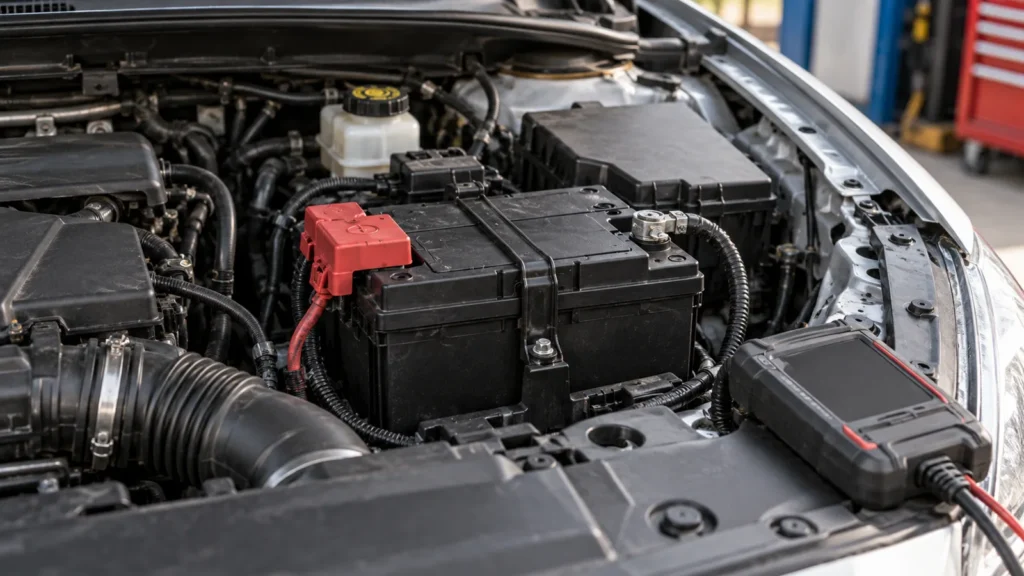
Hero image: AI-generated illustration, not a photograph of a customer repair.
Start with the pattern: overnight or after weeks?
Write down the time between the last successful drive and the failed start. A car that struggles after several weeks parked presents a different diagnostic starting point from one that repeatedly fails the morning after normal use.
- After infrequent use: normal parked electrical demand and too little replenishment may be relevant.
- After repeated short journeys: the battery may not recover the energy used for starting and accessories.
- Despite regular use: ask for battery condition, charging and connection checks rather than assuming a longer journey will cure it.
- After fitting an accessory: tell the technician what changed, including dashcams, trackers or audio equipment.
These are clues, not proof. VARTA explains that short-distance use and parked electrical systems can contribute to discharge. It does not follow that every overnight failure is an accessory fault.
What is parasitic battery drain?
A parked vehicle can still use a small amount of electricity for security and stored electronic settings. An excessive or persistent demand can flatten its 12V battery. Diagnosing that requires knowing which systems should be asleep and what the manufacturer considers normal.
Do not start disconnecting fuses or inserting a multimeter into the battery circuit to follow a generic internet test. Testing needs to account for the vehicle’s electrical design; opening doors or waking systems can change the result. Ask for a properly controlled drain investigation if initial battery and charging checks do not explain the fault.
Battery or alternator: what should be tested?
A battery test and a charging-system check answer different questions. The first assesses whether the battery can provide starting power; the second investigates whether the vehicle replenishes it correctly. Terminal and earth-cable checks help identify connection problems that can mimic a weak battery.
A single voltage reading is not a complete diagnosis. Ask what the test showed, whether the battery needed charging before assessment and why a particular part is recommended. Our alternator guide explains charging faults in more detail.
Why can a new battery go flat?
A replacement battery does not remove an electrical drain or repair a charging fault. Confirm that the replacement meets the vehicle specification and that any manufacturer-required registration or adaptation has been completed.
Before authorising another replacement, give the provider the previous invoice, battery details and dates of each failure. Ask whether the proposed work addresses a measured fault or only restores starting temporarily.
Safe checks before your appointment
- Check that lights and accessories have been switched off and doors and the boot are properly shut.
- Note journey length, parking periods, recent electrical work and the age of the battery if known.
- With the engine off, look for obvious case damage or corrosion without touching exposed conductors or leaking material.
- Keep any warning messages or previous test reports. Ask a passenger to record symptoms safely; do not film while driving.
Do not charge or jump-start a swollen, leaking or visibly damaged battery. For an undamaged battery, follow the vehicle handbook and charger instructions, including designated connection points and battery-type compatibility. Stop if you are unsure and arrange assistance.
Will a short drive after a jump-start fix it?
Not reliably. A successful jump-start establishes that the car started with assistance; it does not establish battery health or remove the original cause. Arrange testing after repeated failures instead of treating each jump-start as a repair.
The AA’s breakdown guidance identifies infrequent use, charging faults and battery faults among the causes of flat batteries. If the vehicle is stranded, use suitable roadside assistance rather than booking a normal journey you cannot complete safely.
Related guides
- Car clicks but will not start
- Battery terminal corrosion and slow starting
- Choosing and looking after a car battery
Book it with HON CAR SERVICE
Use diagnosis to distinguish a discharged battery from a failed battery or charging fault. Explore available services and check eligibility for your vehicle and postcode. Describe an undiagnosed fault before choosing replacement parts.