
Battery Terminal Corrosion: Causes, Slow Starting and Safe Cleaning
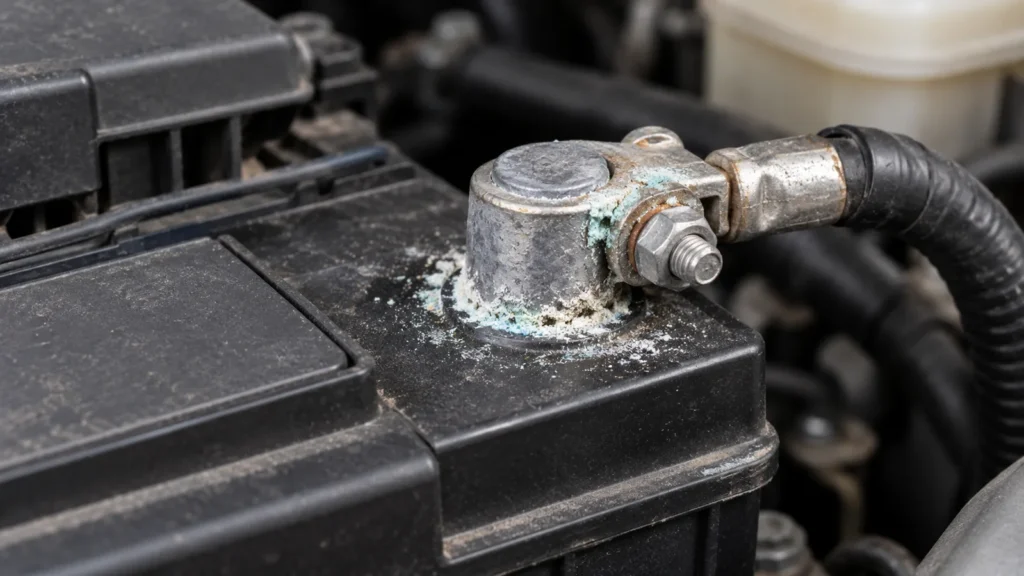
White or green deposits on car battery terminals? Learn how corrosion affects starting, when cleaning is safe and when a battery or charging-system test is needed.
White or blue-green deposits around car battery terminals are a reason to inspect the connections, especially if the engine turns slowly when starting. Corrosion can interfere with electrical contact, but it does not prove the battery needs replacing. A weak battery, loose cable, poor earth connection or starter fault can produce similar symptoms.
Have the battery and connections assessed before replacing parts.
What causes battery terminal corrosion?
The deposits are corrosion products around the metal posts, clamps or cable connections. Heat, charging conditions and leakage around a damaged battery can be relevant. The colour depends partly on the metals involved; white or green deposits alone cannot tell you whether the battery or alternator is faulty.
Corrosion may occur on a battery that still works. Repeated or heavy build-up deserves investigation rather than repeated cosmetic cleaning. Tell the technician if it returns quickly, appears beside a damaged post or accompanies unreliable starting.
Can corrosion make a car slow to start?
Yes. VARTA warns that terminal corrosion can affect battery performance. A poor connection can interfere with the supply needed for starting, so terminals and cables belong in the inspection as well as the battery itself.
Distinguish a slowly turning engine from one that turns at normal speed but does not fire. The AA lists battery, starter, wiring, charging and fuel-system faults among starting problems. Clicking or dimming lights are useful observations, not a definite diagnosis. Working dashboard lights do not by themselves prove that the battery can supply the starter.
When should you leave the battery alone?
Do not attempt cleaning if the battery is cracked, swollen, leaking, unusually hot, smoking or giving off a strong unusual smell. Stop using it and seek professional advice. Avoid charging or jump-starting a damaged battery. Battery acid can burn skin and eyes; batteries can also release flammable gas.
This guide concerns accessible conventional 12-volt lead-acid starter batteries. It is not a procedure for lithium batteries, traction batteries or high-voltage equipment. On hybrids and EVs, keep away from orange cables and high-voltage components. Switching the vehicle off does not establish that those systems are safe to work on.
Also stop if you cannot identify the terminals, the clamp is badly damaged, a battery-monitoring sensor is involved or the handbook does not describe a suitable disconnection procedure. Modern vehicles can require specific shutdown, reconnection or relearning steps. Ask a competent technician rather than improvising a memory-saver connection.
How are corroded battery terminals cleaned safely?
Only proceed with a sound, accessible battery if the vehicle and battery instructions permit it and you are confident carrying out the work. Use proper eye protection and suitable protective gloves, remove metal jewellery, and work in a ventilated area away from cigarettes, flames and sparks. Never bridge the terminals or let a metal tool connect the positive terminal to bodywork.
- Prepare the vehicle. Park securely, switch off the ignition and electrical equipment, and follow the handbook's shutdown and waiting instructions.
- Disconnect in the specified order. On a conventional negative-earth vehicle, remove the negative connection first, then positive. Keep disconnected leads from springing back onto the posts. If the layout differs or you are unsure, stop.
- Clean carefully. Use a suitable battery-terminal cleaner as directed. Battery manufacturers also describe brushing isolated terminals and connectors with a dilute bicarbonate-of-soda and water solution. Use a small controlled amount; do not flood the engine bay, brush debris towards yourself or allow cleaner into battery vents or cells.
- Dry and inspect. Remove residue, leave surfaces dry and check for damaged clamps or cables. Cleaning cannot restore a broken connection. Do not open sealed battery valves or add water to a sealed battery.
- Reconnect correctly. For the conventional negative-earth arrangement, positive goes on first and negative last. Tighten to the vehicle's specification, avoid overtightening and refit protective covers. Use any protective terminal treatment according to its instructions.
If a terminal will not release normally, do not hammer the post or force a seized clamp. Stop and arrange help. Collect cleaning residue safely and follow the cleaner's disposal instructions; wash your hands afterwards.
Does cleaning mean the battery is fixed?
No. It addresses contamination at the connection, not necessarily the cause of the starting fault. If starting remains slow, the corrosion returns or the battery repeatedly goes flat, ask for battery-condition and charging-system checks alongside the connections. Agree the diagnosis before authorising a replacement battery or alternator.
If a new battery is required, its type and specification must suit the vehicle. Ask whether a battery-management reset or registration is required. Do not replace an AGM or EFB start-stop battery with an unsuitable alternative just because it fits the tray.
Quick questions
Does green corrosion mean the battery is dead?
No. Colour is not a battery test. A sound battery may only need its connections attended to, while an apparently clean battery can still be weak.
Can I pour cola or boiling water over it?
Avoid improvised drinks and flooding methods. Use the battery maker's cleaning guidance and keep liquid away from openings and electronics. If safe isolation is uncertain, arrange professional cleaning.
Describe the symptoms and check availability for your vehicle and postcode.
Related reading
Sources and safety guidance
- VARTA: battery handling, disconnection and reconnection
- VARTA: terminal maintenance
- GS Yuasa: protective equipment and short-circuit precautions
- Interstate Batteries: corrosion and cleaning
- The AA: starting-fault symptoms
- HSE: electric and hybrid vehicle hazards
Written by HON CAR SERVICE. General guidance does not replace the vehicle and battery instructions. Hero image is an original AI-generated illustration.