
Start-Stop Car Batteries: Getting the Replacement Right
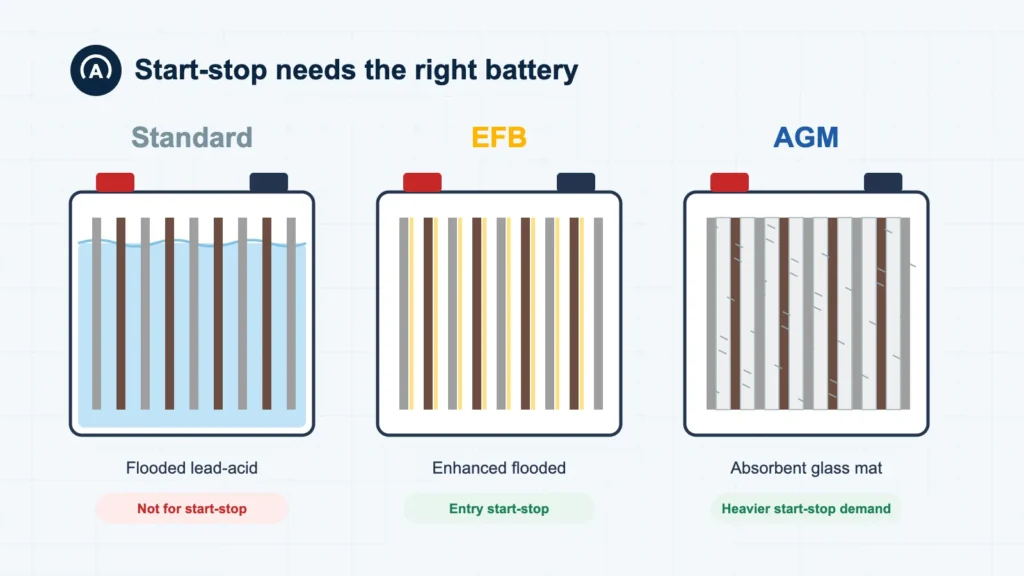
EFB or AGM? Learn why the battery type and coding matter, and how to get a start-stop car battery replacement right first time.
A start-stop car needs an EFB or AGM battery, not a standard one, and the replacement should match the type the car was built with. On many models the new battery must also be registered or coded to the battery management system. Get either step wrong and a car battery replacement can leave you with a short-lived battery and a start-stop system that no longer works. The good news is that both are easy to get right when you know what to ask for.
This guide explains how start-stop batteries differ, why the type and coding matter, and how to spot that your start-stop battery is near the end of its life.
Why start-stop cars need a different battery
A start-stop system switches the engine off when you stop in traffic and restarts it when you move off. That means far more engine starts than a car without start-stop. While the engine is off, the battery also runs the lights, fans, heater blower and infotainment on its own.
A standard flooded battery is not designed for that pattern of deep, repeated use. EFB and AGM batteries are built to recover quickly and cope with many more charge and discharge cycles.
EFB vs AGM: what is the difference?
| Feature | EFB (enhanced flooded battery) | AGM (absorbent glass mat) |
|---|---|---|
| Construction | Improved version of a flooded battery with liquid electrolyte | Electrolyte held in glass fibre mats, sealed design |
| Typically fitted to | Many entry-level start-stop systems | Start-stop cars with higher electrical demand, often with brake energy recovery |
| Cycling ability | Good | Higher |
| Can it replace a standard battery? | Yes, as an upgrade | Yes, as an upgrade, if the car's charging suits it |
| Safe replacement | EFB or, where approved, AGM | AGM only |
The simple rule: replace like with like, or upgrade where the manufacturer allows it. Never downgrade.
Getting your car battery replacement right
1. Identify what is fitted now
Check the label on the existing battery for EFB or AGM, and confirm it against the car's specification. A previous owner or garage may already have fitted the wrong type, so the label alone is not proof. Entering your registration when you book helps match the right battery to your exact car.
2. Match the size and rating
The new battery must match the physical size and terminal layout, as well as the capacity (Ah) and cold cranking amps (CCA) the car needs. Our car battery guide explains these ratings in plain English.
3. Register or code the new battery
Many start-stop cars have a battery management system that monitors the battery's age and condition and adjusts how it is charged. When a new battery is fitted, the car needs to be told, using diagnostic equipment. If it is not registered, the system may keep charging the new battery as if it were the old, worn one. That can shorten its life and stop start-stop working properly.
4. Check the charging system
A quick check of charging voltage and stored fault codes confirms the new battery is being looked after.
Enter your registration and postcode for a fixed price, with the right battery type, fitting and registration where your car needs it.
Signs your start-stop battery is failing
Start-stop often gives the earliest warning, because the car disables it to protect a weak battery. Look out for:
- Start-stop rarely or never switches the engine off, even on a warm engine in normal traffic.
- A start-stop unavailable message or an amber warning symbol on the dashboard.
- Slower cranking on cold mornings.
- Electrical oddities such as the infotainment restarting or warning lights flickering on start-up.
- The battery is past the common 3 to 5 year lifespan.
When start-stop not working is normal
Start-stop can also stay off for good reasons. The engine may still be cold, the heater or air con may be working hard, the driver's door or seatbelt may be open, or the battery may simply need a longer drive to recharge. If start-stop stays off on every journey, though, get the battery tested. If the battery tests fine, a diagnostic inspection can look for sensor or system faults.
Why you should not downgrade
A standard battery may fit the tray and start the car at first, so it can look like a sensible saving. In practice:
- It can wear out much sooner under start-stop use.
- Start-stop may stop working, which can increase fuel use in town.
- Repeated deep drains can leave you with a car that will not start. See why a car battery keeps going flat.
For signs, testing and what happens on the day of any battery job, read our full guide to car battery replacement.
Booking a car repair near me for a start-stop battery
With Hon Car Service, you enter your registration and postcode for a fixed price with parts and labour included. Choose a mobile mechanic at home or work, free collection and return, or drop-off at a trusted local garage. You get live photo updates, approve any extra work first, and your card is only charged after the work is done and approved. You get a 12-month parts and labour warranty. We serve Southampton, Eastleigh, Totton and Romsey, and drivers across the UK.
Frequently asked questions
Can I fit an AGM battery instead of an EFB?
Often yes, as an upgrade, where the manufacturer allows it. Going the other way, from AGM to EFB or standard, is not recommended.
Does every start-stop car battery replacement need coding?
Not every car, but many modern models do. Your registration lets the technician check what your car needs before the job.
Is it safe to drive if start-stop has stopped working?
Usually yes, but it is often an early sign of a weak battery. Get it tested before it leaves you unable to start.
Enter your registration and postcode for a fixed price, with parts and labour included.