
Signs Your Clutch Is Going: 8 Symptoms and What to Do Next
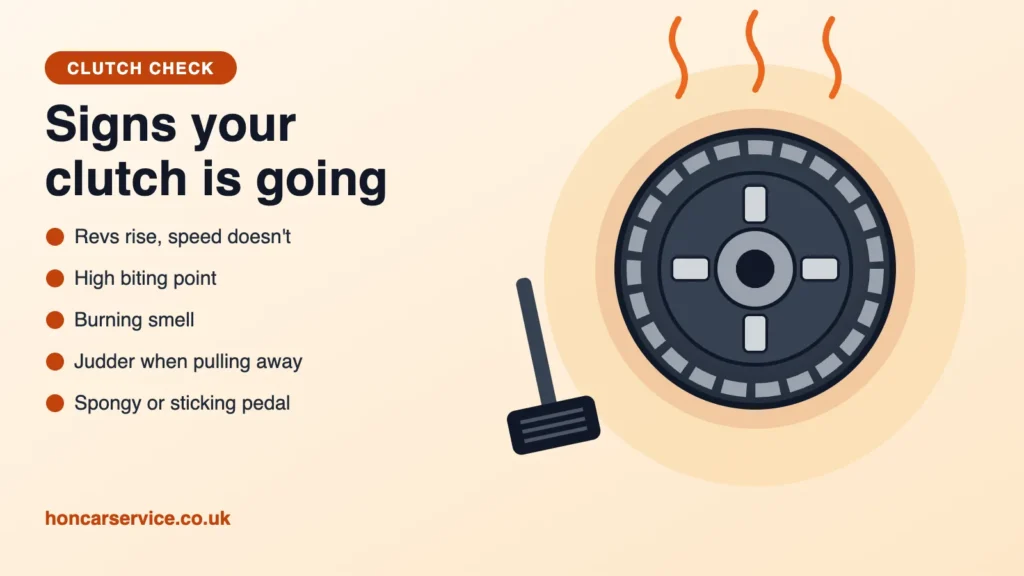
The eight most common signs your clutch is going, from slipping and a high biting point to a burning smell and a spongy pedal, plus simple checks you can do and what to do next.
A clutch rarely fails without warning. In most cars it wears gradually, and the signs show up weeks or months before it gives up completely. Spot them early and you can plan the repair, rather than waiting for a breakdown at the worst possible moment. This guide covers the eight most common signs your clutch is going, how to check them safely, what causes early wear and what to do next.
Quick answer: the main signs your clutch is going
- The engine revs rise but the car doesn't speed up (clutch slip), especially uphill or in a high gear.
- The biting point is higher than it used to be, near the top of the pedal travel.
- A burning smell, a bit like hot brakes, after pulling away on a hill or in heavy traffic.
- Juddering or shuddering as you pull away.
- Gears are hard to select, or grind, especially first and reverse.
- The pedal feels different: spongy, very heavy, or it sticks to the floor.
- New noises: a whirring, squealing or rattling sound when you press or release the pedal.
- Vibration through the pedal or floor at idle or when pulling away.
One sign on its own doesn't always mean a new clutch, but two or more together are a strong reason to have the car checked.
The 8 signs in more detail
1. Clutch slip: revs go up, speed doesn't
This is the classic sign of a worn clutch. The friction plate can no longer grip the flywheel firmly, so some of the engine's power is lost as heat instead of turning the wheels. You'll notice it most when accelerating hard in third, fourth or fifth gear, climbing a hill, towing or carrying a heavy load. It usually starts small and gets worse.
2. A high biting point
As the friction material wears thin, the point where the clutch starts to engage moves further up the pedal. If you now have to lift the pedal almost all the way before the car moves, the clutch may be near the end of its life. Note that some cars have a naturally high biting point, so the key thing is a change from what's normal for your car.
3. A burning smell
A sharp burning smell, similar to overheated brakes, means the clutch has been slipping and overheating. It can happen once after a difficult hill start, but if you notice it regularly in normal driving, the clutch is wearing fast.
4. Juddering when pulling away
A shudder through the car as the clutch engages can point to a worn or contaminated clutch plate, a warped pressure plate or, on many modern diesels and some petrol cars, a worn dual-mass flywheel. Oil leaking onto the clutch from a failing engine or gearbox seal can cause it too.
5. Difficulty selecting gears, or grinding
If the clutch isn't disengaging fully when you press the pedal, the gearbox is still being driven and gears become hard to select. You may hear a grind going into first or reverse. This often points to a hydraulic problem or a worn clutch release mechanism rather than the friction plate itself.
6. A spongy, heavy or sticking pedal
Most modern cars use a hydraulic clutch with a master and slave cylinder. A soft or spongy pedal, a pedal that needs pumping, or one that stays on the floor usually means a fluid leak, air in the system or a failing cylinder. A pedal that has become very heavy can point to a worn pressure plate or a sticking release mechanism. Any sudden change in pedal feel is worth checking quickly, because a hydraulic failure can leave you unable to change gear at all.
7. Noises when you use the pedal
A whirring, squealing or chirping noise that changes when you press or release the pedal often comes from a worn release (thrust) bearing. A rattle at idle that goes away when you press the pedal can be a sign of a worn dual-mass flywheel. Both are usually replaced together with the clutch.
8. Vibration through the pedal or floor
Vibration you can feel through your foot or the floor, particularly when pulling away, can mean worn clutch components or worn engine and gearbox mountings. A mechanic can tell the difference on a road test.
Enter your registration and postcode for a fixed-price clutch quote with parts and labour included, then choose a mobile mechanic or free collection and return.
How to tell if your clutch needs replacing: a simple check
You can't see the clutch without removing the gearbox, but these checks will tell you a lot. Only try them on a quiet, empty road where it's safe and legal to do so.
- Feel the biting point. In a safe place, with the engine running and the handbrake on, select first gear and slowly lift the pedal. Notice where the car starts to bite. If it's right at the top, the clutch is likely worn.
- Watch the rev counter under load. On a clear road, accelerate firmly in third or fourth gear. If the revs jump without the speed rising to match, the clutch is slipping.
- Check the pedal. Press it a few times with the engine off. It should feel consistent and return smoothly. A soft, spongy or sticking pedal points to a hydraulic problem.
- Listen. With the engine idling in neutral, press and release the pedal and listen for any change in noise.
- Look for leaks. On many cars the clutch shares fluid with the brakes. A dropping brake fluid level, or damp patches around the pedal area, need checking straight away.
If two or more of these point to a problem, book a professional inspection. A mechanic will road test the car, check the hydraulics and confirm whether you need a full clutch replacement or a smaller repair, such as a slave cylinder.
What causes a clutch to wear out early?
How long a clutch lasts depends heavily on how and where the car is driven. Many last well beyond 60,000 miles, while others wear out much sooner. The most common causes of early wear are:
- Riding the clutch: resting your foot on the pedal while driving keeps it partly disengaged and wears it faster.
- Holding the car on a hill with the clutch instead of the handbrake or hill-hold.
- Stop-start city traffic, with frequent slipping as you creep forward.
- Towing or carrying heavy loads regularly.
- Fast, high-rev starts and slipping the clutch to pull away quickly.
- Oil contamination from a leaking engine or gearbox seal.
- Hydraulic faults that stop the clutch from engaging or disengaging fully.
Can you drive with a slipping clutch?
You can usually drive a short distance with a slipping clutch, but it isn't a good idea to keep going. Slip gets worse quickly, the heat can damage the flywheel and pressure plate, and the clutch can eventually stop transferring drive altogether, leaving you stranded. Avoid towing, hills and hard acceleration, and get it checked as soon as you can. If the pedal goes to the floor and you can't select gears, don't drive the car.
What happens when you book a clutch repair
With Hon Car Service you enter your car registration and postcode to get an instant fixed-price quote, with parts and labour included. You can then choose a mobile mechanic at your home or work, free collection and return, or a trusted local garage. Some clutch jobs need a ramp or gearbox jack, so if the work needs a workshop we'll arrange free collection and return. If the mechanic finds anything else, you get a separate quote first and nothing is done without your approval. The work comes with a 12-month parts and labour warranty from the mechanic or garage that does the work.
If your car is also due a service, it's often worth doing both at once. See our guide to what is included in a car service, and if you're not sure whether a mobile mechanic can do the job, read what a mobile mechanic can do.
Fixed price, parts and labour included, and a 12-month parts and labour warranty from the mechanic or garage that does the work.
FAQs
How long does a clutch last?
Many clutches last well beyond 60,000 miles, but it varies widely with driving style and conditions. A car used mainly in city traffic or for towing will usually need a clutch sooner than one used on motorways.
What does a slipping clutch feel like?
The engine revs rise when you accelerate, but the car doesn't speed up to match. It's most noticeable in higher gears, uphill or with a heavy load.
Is a spongy clutch pedal dangerous?
It can be. A spongy pedal usually points to a hydraulic problem, such as a leak or air in the system, and it can get worse suddenly. Have it checked as soon as possible.
Does a clutch problem affect the MOT?
The MOT doesn't test clutch wear directly, but leaks and some related faults can be picked up during the test. A failing clutch is also likely to get worse, so it's best to fix it whether or not your MOT is due. See our car MOT test page.
Is it the clutch or the gearbox?
Slipping, a high biting point and a burning smell usually point to the clutch. Whining that changes with road speed, or jumping out of gear, can point to the gearbox. A road test by a mechanic will confirm it.