
Car Service Schedules Explained: Time, Mileage or Variable
Is your next car service due by time, mileage or a variable schedule? Learn how each works and how short trips or towing change it.
Most cars follow a fixed schedule based on time or mileage, whichever comes first, while some use a variable or long-life schedule where the car works out when the next car service is due. Knowing which one your car uses, and how your driving affects it, tells you when to book. Getting this right protects the engine, keeps the warranty valid and avoids paying for work the car does not yet need.
This guide explains each type of schedule, where to find yours and when it makes sense to service sooner than the dashboard suggests.
Fixed schedules: time or mileage, whichever comes first
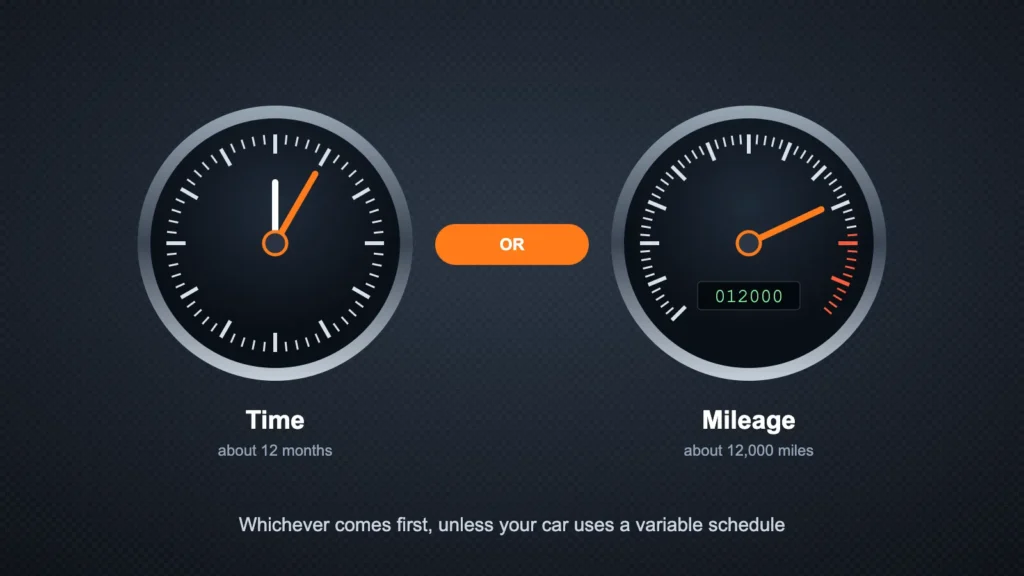
A fixed schedule gives two limits for each service, such as a number of months and a number of miles. The service is due when you reach either one, whichever comes first.
Intervals vary by manufacturer, but typically:
- Interim service: about every 6 months or 6,000 miles.
- Full service: about every 12 months or 12,000 miles.
- Major service: about every 24 months, adding items such as spark plugs, fuel filter and cabin filter, depending on the car.
Why the time limit matters
Drivers who cover few miles often think they can skip a year. They cannot. Engine oil and brake fluid age even when the car is parked, and brake fluid is commonly changed about every 2 years, whatever the mileage. Our guide to low mileage car servicing explains why time matters as much as miles.
Variable and long-life schedules
On a variable schedule, the car monitors how it is used, often including engine running time, temperatures and journey length, and calculates when the next service is due. The countdown is shown on the dashboard or in the infotainment menu.
These schedules can allow longer gaps between services when the car is mostly used for long, steady journeys. They usually depend on:
- the exact oil specification the manufacturer requires,
- regular checks of oil level between services,
- the service indicator being reset correctly after each visit.
A car on a variable schedule that is mostly used for short town trips may ask for a service much sooner than you expect. That is the system working as designed, not a fault. If a reminder appears, our guide on what to do when the service light comes on explains the next steps.
Compare car service schedule types
| Schedule type | How it works | Suits | Watch out for |
|---|---|---|---|
| Fixed (time or mileage) | Set months and miles, whichever comes first | Most drivers, and anyone who likes a predictable date | Missing the time limit on a low-mileage car |
| Variable or long-life | The car calculates the due date from how it is driven | Regular long journeys at steady speeds | Wrong oil specification, or an indicator not reset after the last service |
| Severe or arduous use | Shorter intervals listed in the handbook for hard use | Short trips, towing, heavy loads, dusty roads, stop-start town driving | Following the standard schedule when your use counts as severe |
How your driving changes what the car needs
Handbooks often describe "severe" or "arduous" conditions, and many everyday drivers fall into them without realising it.
Short trips
Journeys of a few miles do not let the engine reach full temperature. Moisture and fuel can collect in the oil, and diesel cars may struggle to clean their particulate filter. If most of your driving is the school run or a short commute, consider servicing towards the shorter end of the range.
Towing and heavy loads
Towing a caravan or trailer puts extra strain on the engine, gearbox and brakes. Check the handbook for a towing schedule and have the brakes looked at before a long trip.
High mileage
If you cover well over 12,000 miles a year, you will reach the mileage limit long before the time limit. Adding an interim service between full services keeps oil fresh and lets a mechanic spot wear early. Our guide to interim, full and major services shows what each one includes.
Enter your registration and postcode for a fixed price that follows your car's schedule, with parts and labour included.
Where to find your car's schedule
- The handbook or service booklet: lists the intervals and what each service includes.
- The dashboard or infotainment menu: shows the days or miles left on most modern cars.
- The last invoice: should state the service type and the mileage, so you can work out the next one.
- The digital service record: many newer cars no longer use a paper stamp.
- A mechanic: can look up the manufacturer's schedule from your registration.
Keeping the warranty valid
Under UK block exemption rules, an independent garage can service a car that is still under warranty, as long as it follows the manufacturer's schedule and uses parts of matching quality. Keep every invoice as proof. Our guide to what a service includes shows what a proper invoice should list.
When you book through Hon, the price is based on your car's registration, so the work matches its schedule. You can choose a mobile mechanic at home or work, free collection and return, or drop-off at a trusted local garage. Work comes with a 12-month parts and labour warranty from the mechanic or garage that does the work.
Frequently asked questions
Is my car service due by time or mileage?
On a fixed schedule, it is due at whichever limit you reach first. On a variable schedule, follow the reminder on the dashboard, but do not go beyond the maximum time the handbook allows.
Can I switch from a variable to a fixed schedule?
On some cars it is possible. Ask a technician whether your car allows it and what it means for the oil specification.
How do I find a car service near me that follows the schedule?
Enter your registration and postcode for a car service near me quote. The fixed price reflects the service your car needs, and you approve any extra work before it starts.
Enter your registration and postcode for a fixed price, with parts and labour included.