
Is a Full Service Worth It? Full Service Cost Versus Value
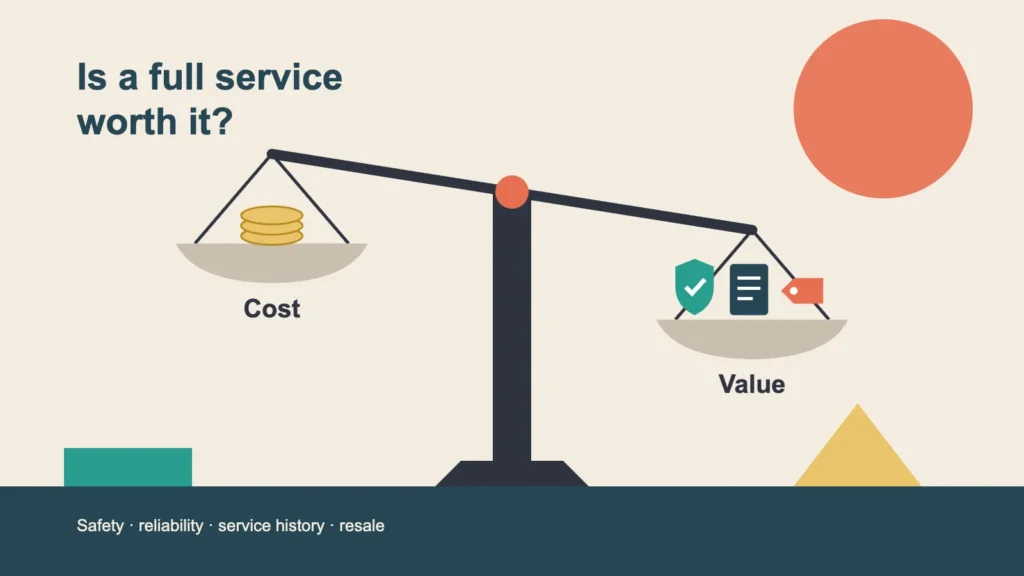
Is the full service cost worth it? See what a full service adds over an interim, who needs which, and a simple decision table.
For most drivers, a full service is worth it once a year, because it covers far more than an interim service and keeps your service history complete. When you weigh the full service cost against what it checks and replaces, the value comes from catching wear early, protecting resale and warranty, and avoiding bigger repairs later. Whether you need a full service, an interim or a major depends on your mileage, your car's age and how you use it.
This guide explains what a full service adds, who benefits most, where the long-term value lies, and how to decide which level is right for your car.
What a full service adds over an interim
Service levels are typically grouped like this, although intervals vary by manufacturer:
- Interim: typically about every 6 months or 6,000 miles. Usually an oil and oil filter change, plus key safety checks such as lights, tyres, brakes and fluid levels.
- Full: typically about every 12 months or 12,000 miles. Everything in an interim, plus more filters and a longer, more detailed inspection.
- Major: typically about every 24 months, adding items such as spark plugs, fuel filter and cabin filter depending on the car.
Depending on the car and its schedule, a full service commonly adds items such as:
- an air filter change, and on many cars the cabin (pollen) filter;
- a more detailed brake inspection, including pads, discs and brake fluid condition;
- checks of steering, suspension, drive shafts and exhaust;
- a closer look at the battery, charging system and auxiliary belt;
- a fuller inspection of tyres, wheels and underbody;
- an updated service record.
For the full checklist, see what a full service includes, and for a side-by-side view of all three levels, read our guide to interim, full and major services.
Who needs which service?
Annual drivers with average mileage
If you drive a typical annual mileage, a full service once a year usually matches the schedule. It keeps the record complete and puts a qualified eye on the whole car every 12 months.
High-mileage drivers
If you cover a lot of miles, you may reach the mileage interval long before 12 months. Many high-mileage drivers alternate an interim and a full service across the year to keep fresh oil in the engine.
Low-mileage and older cars
Low mileage does not mean no wear. Oil ages over time, and rubber parts, brakes and batteries can suffer from a car standing still. Our guide to low-mileage servicing explains why time-based servicing still matters.
Cars on variable or long-life schedules
Some cars calculate their own service intervals. Follow the car's indicator and the manufacturer's schedule, rather than a fixed calendar.
Enter your registration and postcode for a fixed price with parts and labour included, at home, at work or at a trusted local garage.
Full service cost versus long-term value
The full service cost is higher than an interim because it includes more parts and more of the mechanic's time. The question is what you get back for it.
- Early warnings: a longer inspection can spot worn brakes, perished tyres or a weak battery before they fail or cause an MOT fail.
- Engine protection: fresh oil and clean filters help the engine run as it was designed to.
- Resale value: buyers look for a complete, consistent service history. Gaps can make a car harder to sell.
- Warranty: under UK block exemption rules, an independent garage can service a car in warranty, as long as it follows the manufacturer's schedule and uses parts of matching quality. Skipping scheduled items can cause problems with a claim.
Our guide on why regular servicing saves money looks at the long-term picture in more detail.
What sets your full service cost
The price depends on your engine, the oil specification, the filters due, your fuel type and how long your model takes to work on. Our guide to the factors behind service pricing explains each one. The simplest way to see your exact figure is a fixed quote using your registration and postcode.
Decision guide: interim, full or major?
| Your situation | Usually the right choice | Why |
|---|---|---|
| Last full service was about 12 months ago | Full service | Matches the typical annual schedule |
| About 6 months or 6,000 miles since a full service | Interim service | Fresh oil and safety checks between full services |
| About 24 months since the last major service | Major service | Adds items such as plugs and extra filters |
| Service history unknown or patchy | Full or major service | Resets the baseline when records are missing |
| Car in warranty | Whatever the schedule says | Keeps the record in line with the manufacturer |
| Very low mileage, more than a year since the last service | Full service | Oil and rubber parts age with time |
Always check your handbook or service record first, as manufacturer schedules take priority over these general guides.
Getting the most from a full service
- Book it alongside your MOT if both are due. Booked with a service, Hon's MOT is discounted and carried out at an approved MOT test centre, with free collection and return.
- Tell the mechanic about any noises, warning lights or leaks.
- Ask for the findings and any advisories in writing, and keep the record.
With Hon Car Service, you get live photo updates, approve any extra work first, and your card is only charged after the work is done and approved. The work carries a 12-month parts and labour warranty from the mechanic or garage that does the work. Hon covers Southampton and Hampshire, and across the UK. If you are ready to book a car service, you can do it online 24/7.
Frequently asked questions
Is the full service cost worth paying every year?
For most cars, yes. It matches the typical annual schedule, gives a thorough inspection and keeps your service history complete, which supports resale and warranty.
Can I just do interim services instead?
Interim services alone skip filters and checks that a full service covers. Over time, items can be missed. Most drivers are better off with at least one full service a year.
Will a full service affect my warranty?
Servicing to the manufacturer's schedule, with parts of matching quality, helps protect it. Under block exemption, this can be done by an independent garage, not only a dealer.
Enter your registration and postcode for a fixed price, with parts and labour included.