
Engine Oil Level Rising? Causes and What to Do
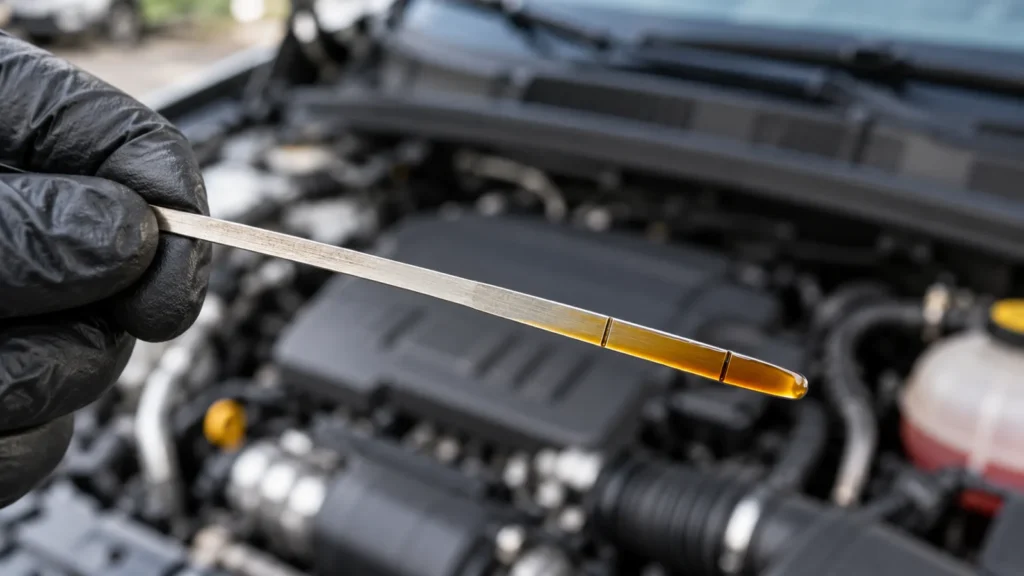
Engine oil level rising without topping up? Understand fuel dilution, coolant leaks and overfilling, when to stop driving and why diagnosis matters.
If your engine oil level keeps rising without a top-up, arrange a check rather than assuming the extra liquid is harmless. Fuel dilution and coolant contamination are possible explanations. A leaking injector or failed head gasket can be involved, but neither can be diagnosed from a dipstick alone. First rule out an inconsistent reading or an overfill.
Describe the symptoms before arranging a diagnostic inspection.
Is the oil actually rising, or was it overfilled?
A high reading after an oil change is different from a level that steadily climbs over several checks. Tell the workshop when it was last serviced and whether anyone has added oil since. Check on level ground, using your handbook's engine-temperature and waiting-time instructions; do not start an already suspect engine just to warm it up.
For a conventional dipstick, wipe it, fully reinsert it and read it again. Electronic oil-level systems have their own measurement conditions. Compare readings taken in the same conditions and photograph them with the date and mileage. Our engine oil level checking guide covers the basic technique.
Can a leaking injector make the oil level rise?
Yes. Faulty injection can leave unburnt fuel in a cylinder, where it can pass the piston rings and reach the sump. That adds liquid while weakening the oil's lubricating film. An injector fault is one possible cause, not the only explanation for fuel dilution.
Motorservice's technical guidance also identifies poor combustion and repeated short-distance operation among relevant factors. A mechanic needs to investigate the engine and its use before recommending injector replacement. A fault-code scan alone is not a conclusive injector test.
Diesel DPF regeneration and short journeys
Some diesel engines can accumulate fuel in the oil during particulate-filter regeneration. Mazda's diesel guidance includes model-specific oil-level monitoring and an additional dipstick mark on some engines. That mark is not a universal allowance for every diesel: use the instructions for your exact model.
Do not take a car with a confirmed high or contaminated oil level on a motorway run to try to clear its DPF. Ask for advice first. The reason for repeated regeneration attempts, and whether the oil needs replacing, must be assessed together.
Can this happen to a petrol engine too?
Yes. Mazda's technical information for specified direct-injection petrol models describes fuel accumulation during very short journeys when the engine remains cool. It is evidence that fuel dilution does not automatically prove a failed injector. The bulletin is model-specific, not permission to ignore a rising level in a different car.
Can a head gasket cause coolant to enter the oil?
Yes, but the head gasket is one of several possible internal leak paths. The Filter Manufacturers Council also identifies damaged cylinder heads or blocks and leaking oil coolers. Coolant-contaminated oil can seriously damage an engine because it no longer lubricates properly.
Tell the technician about any coolant loss or milky-looking oil. Those observations help guide the investigation; appearance alone cannot identify the failed component. Check the coolant reservoir only as your handbook permits and when the engine is cold. Never remove a hot cooling-system pressure cap.
Can you drive with the oil above maximum?
Do not continue normal driving with a confirmed unexplained rise above the permitted level. Contact a repairer or breakdown provider for advice on moving the car safely. Do not add more oil or simply drain some and assume the cause has disappeared.
If the oil-pressure warning appears with the engine running, stop somewhere safe and switch the engine off. Ford's warning-light guidance gives this instruction and calls for immediate inspection where the level is adequate. Overheating, severe rough running, unusual mechanical noise or visible contamination also warrant urgent professional advice.
What should you tell the mechanic?
- The registration, engine/fuel type and last service date.
- Whether the level rose gradually or was high immediately after a service.
- Any top-ups, warning messages, coolant loss or changes in starting and running.
- Your usual journey length and any recent DPF-related warnings.
Ask for the suspected cause, the evidence supporting it and the proposed repair before authorising parts. Depending on the findings, further oil, cooling-system or fuel-system tests may be needed. Agree any additional diagnostic work and its cost first.
Will an oil change fix the problem?
It may be necessary to replace contaminated oil and the filter, but an oil change does not repair a leak or injection fault. The cause and the lubricant condition need to be addressed together. Follow the vehicle's required oil specification and any applicable oil-monitor reset procedure.
Check options for your vehicle and postcode. If it may be unsafe to drive, seek advice before moving it.
Related reading
- How to check your engine oil level
- Low-mileage servicing and short journeys
- Mobile mechanic or garage?
Technical sources
- Motorservice: Oil consumption and oil loss, sections 1.4, 2.6 and 2.7
- Mazda service alert SA-026/18: fuel dilution in specified petrol models (2018)
- Mazda CX-8 diesel oil-level guidance (Australia, 2023; model-specific)
- Filter Manufacturers Council bulletin 89-1: coolant leaks into engine oil (2012 revision)
- Ford UK: oil-pressure warning guidance
Written by HON CAR SERVICE. General guidance; follow your vehicle handbook and professional diagnosis. Hero image is an original AI-generated illustration.