
Driving in Fog: When to Use Fog Lights (UK Rules)
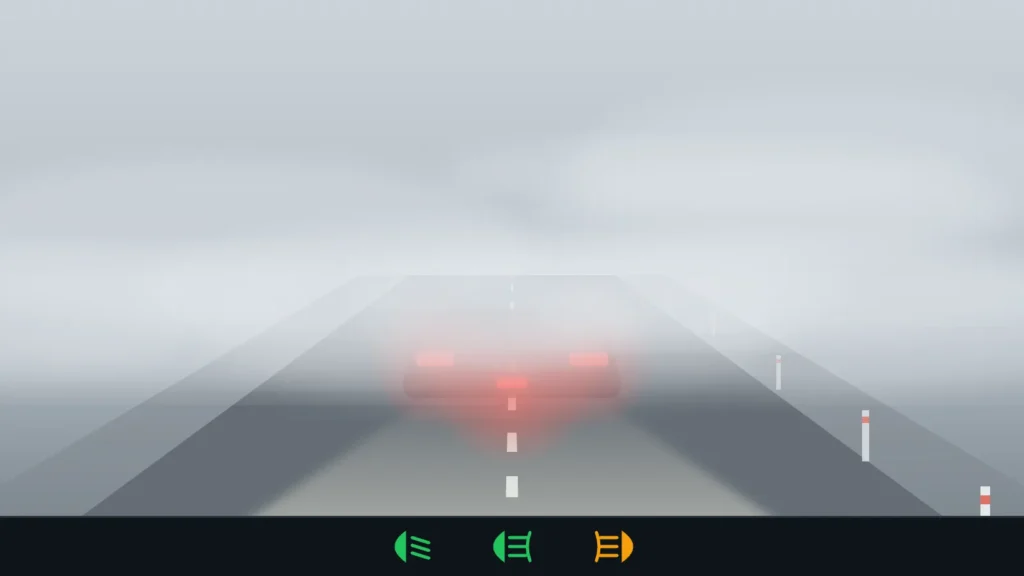
When should you use fog lights in the UK? The 100-metre rule, how to drive safely in fog, the daytime running light trap and the MOT rules for fog lights.
Fog is common on still autumn and winter mornings, and it can turn a familiar road into one where you can barely see the car in front. Fog lights help, but only if you use them at the right time: switch them on too early and you dazzle other drivers, leave them on too long and you can hide your own brake lights. This guide explains exactly when to use fog lights under UK rules, how to drive safely in fog, a lighting trap that catches many modern cars, and what the MOT checks.
Quick answer: when should you use fog lights?
- Use dipped headlights whenever visibility is seriously reduced. The Highway Code says this generally means when you can't see for more than 100 metres (328 feet).
- You may also use front or rear fog lights in those conditions.
- Switch fog lights off as soon as visibility improves. They dazzle other road users and can hide your brake lights.
- Don't use full beam in fog. The light reflects back off the fog and makes it harder to see.
What the Highway Code says about fog
Rule 226 says you must use headlights when visibility is seriously reduced, generally when you cannot see for more than 100 metres. You may also use front or rear fog lights, but you must switch them off when visibility improves.
Rule 236 adds that you must not use front or rear fog lights unless visibility is seriously reduced, because they dazzle other road users and can obscure your brake lights. Where the Highway Code says "must" or "must not", it is a legal requirement.
How far is 100 metres?
Roughly the length of a football pitch. On motorways, the small marker posts on the verge are about 100 metres apart, so if you can't see the next post, visibility is seriously reduced.
The daytime running light trap
Most modern cars have daytime running lights (DRLs) that come on automatically at the front. On many models, the rear lights stay off when only the DRLs are on. In fog or gloom, the car looks lit from the front, but from behind it can be almost invisible.
Automatic headlights don't always help either, because the light sensor measures how dark it is, not how far you can see. On a bright, foggy morning the car may decide the headlights aren't needed. In fog, switch your dipped headlights on manually and check that the light symbol on the dashboard confirms they are on.
Enter your registration and postcode for a fixed price, then choose a mobile mechanic at home or work, free collection and return, or a trusted local garage.
How to drive safely in fog
Rules 234 and 235 of the Highway Code set out the basics. In practice:
- Check your mirrors, then slow down before you enter fog. If a sign says "Fog" but the road looks clear, expect a bank of fog or patchy fog ahead.
- Drive so you can stop well within the distance you can see clearly. This matters most on motorways and dual carriageways, where traffic is faster.
- Keep a safe distance from the car in front. Following someone's rear lights can give you a false sense of security.
- Use your wipers and demisters to keep the glass clear inside and out.
- Watch for drivers who haven't switched their headlights on.
- Don't speed up to get away from someone close behind you.
- Check your mirrors before you slow down, then use your brakes so your brake lights warn the drivers behind.
- At a junction with limited visibility, stop in the correct position and listen for traffic. When you're sure it's safe, pull out positively rather than hesitating in the path of oncoming vehicles.
- Switch your fog lights off when the fog clears. It's easy to forget, and rear fog lights are bright enough to dazzle the driver behind and hide your brake lights.
Front and rear fog lights: what's the difference?
- Rear fog lights are very bright red lights that make you visible from behind in thick fog. Most cars have one (fitted in the centre or on the driver's side) or two. A warning light on the dashboard shows when they are on.
- Front fog lights are fitted low in the front bumper on some cars. They throw a wide, flat beam under the fog to help light the road edges and other drivers see you. Not every car has them.
Check your handbook to see which switch controls which light. On many cars the fog lights only work when the dipped headlights or sidelights are on. Our guide to dashboard warning light colours explains what the symbols on your dashboard mean.
Check your fog lights before winter
It takes two minutes. With the car parked safely, switch on the dipped headlights, then the front and rear fog lights, and walk round the car. If you're on your own, check the reflection in a garage door or shop window. Look for a dead bulb, a cracked lens or a dashboard warning light that doesn't come on. While you're there, check your brake lights, indicators and number plate lights too. Our car lights guide explains what each light does, and our winter car service checklist covers the other cold-weather checks.
Fog lights and your MOT
Fog lights are part of the MOT. Under the MOT inspection manual:
- Cars first used on or after 1 April 1980 must have at least one rear fog light, fitted in the centre or on the offside (the driver's side in the UK).
- A missing or inoperative rear fog light is a major defect, which means an MOT fail. So is a switch that doesn't work, a light that isn't a steady red, or a lens defect that affects the light.
- The rear fog light's dashboard warning light must work where a rear fog light is compulsory. A missing or inoperative warning light is also a major defect.
- Front fog lights are inspected on vehicles first used on or after 1 March 2018, if they are fitted.
A blown bulb is one of the easiest MOT fails to avoid, so check every light before your test. If you're looking for an MOT near me, you can book your MOT online. It is carried out at an approved MOT test centre and is discounted when you book it with a service. Our guide to the most common MOT failure reasons explains the other quick checks worth doing.
How Hon Car Service can help
Hon Car Service is an online booking platform for car servicing, MOTs and repairs across the UK. If a fog light, headlight or brake light isn't working, or your headlights are misaligned, enter your car registration and postcode for an instant fixed price with parts and labour included. Choose a mobile mechanic at your home or work, free collection and return, or a trusted local garage. Your card is pre-authorised when you book and only charged after the work is done and approved, and every job comes with a 12-month parts and labour warranty.
Book your MOT and service together at an approved test centre, with a fixed price and a 12-month parts and labour warranty on repairs.
FAQs
When should I use fog lights in the UK?
Only when visibility is seriously reduced, which the Highway Code says is generally when you can't see for more than 100 metres. Use dipped headlights as well, and switch the fog lights off as soon as visibility improves.
Is it illegal to drive with fog lights on when it isn't foggy?
Yes. Rule 236 says you must not use front or rear fog lights unless visibility is seriously reduced, because they dazzle other road users and can hide your brake lights.
Should I use full beam in fog?
No. Full beam reflects off the water droplets in fog and makes it harder to see. Use dipped headlights, plus fog lights if visibility is below about 100 metres.
Why didn't my automatic headlights come on in fog?
The sensor measures how dark it is, not how far you can see, so on a bright, foggy day it may leave the headlights off. Switch your dipped headlights on manually in fog.
Will a broken fog light fail the MOT?
A missing or inoperative rear fog light is a major defect on cars first used on or after 1 April 1980, so yes. Front fog lights are checked on vehicles first used on or after 1 March 2018 if they are fitted.
Do I need front fog lights?
No. Front fog lights are optional, but the compulsory rear fog light must work on cars first used on or after 1 April 1980.